Air rights in Monaco: understanding the right to raise buildings
Publié par Paolo Petrini le 18/11/2025
Temps de lecture
16
min.
Real Estate Advice
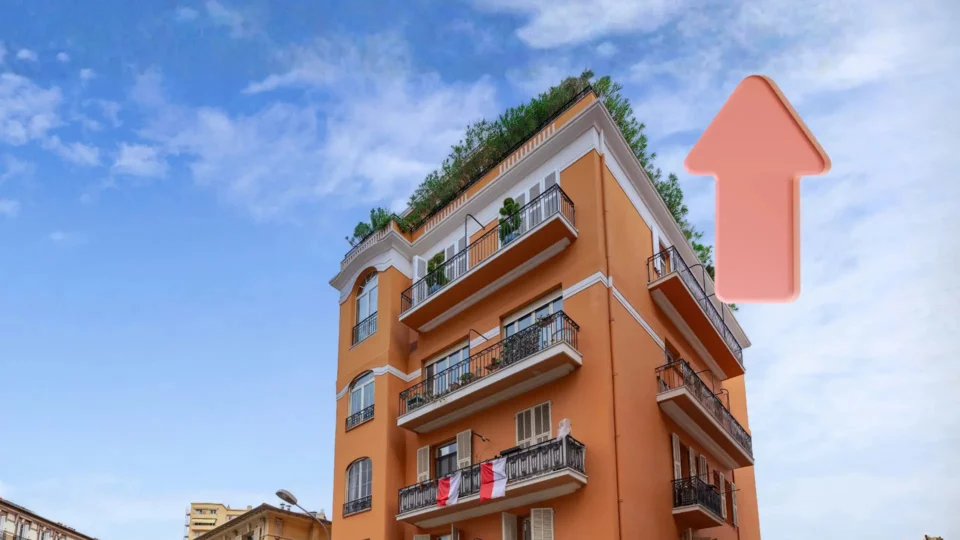
In Monaco, the scarcity of land has given rise to a unique concept in the European property landscape: air rights. In this city‑state of 2.08 km² where every plot counts, even the space located above a building can become a valuable asset. These air rights refer to the volume of space overhanging a structure—an intangible area that Monegasque regulations allow to be transformed into buildable surface, notably by adding extra storeys.
Discover our selection of apartments
for sale in Monaco
for sale in Monaco
Studios, one- to five-bedroom apartments, penthouses and prestigious properties
This notion has become strategic in a territory where horizontal expansion is almost impossible. We have already described this phenomenon several times, for example in our analyses of the vertical extension of the Beau‑Rivage building, a project that enlarges an existing building. Today in Monaco, it is one of the most important levers for creating new housing and optimising existing buildings. It falls within a precise legal framework and a well‑established urban practice: building upwards to meet growing demand.
How does this practice work and under what conditions can one “monetise the sky” of Monaco? A complete analysis of this unique property lever—from its strict legal framework to concrete examples that shape the Monegasque skyline.
What is meant by air rights in Monaco?
In Monaco, “air rights” are not simply the air you breathe when you open your window. It is an intangible volume located above a building—a potential extra floor, a panoramic rooftop or even a rooftop pool. The notion implies that the sky has a price. The right to occupy this aerial space is legally recognised as a real property right, similar to a surface right. It allows the ownership of the land to be separated from that of the volumes to be built above, offering unprecedented flexibility in a saturated market.
In concrete terms, the owner of a building can own or transfer this right to build upwards independently of the existing structure. This right can be sold, transferred or mortgaged like any other property asset. Eugenia Petrini, an expert in buying and selling air rights in Monaco, confirms that she has already closed several such transactions. She explains :
“It is a strategic purchase. In Monaco, the right to airspace generally belongs to the co‑ownership, but it can also be held by an individual when it has been transferred by deed. When the owner of the top floor buys back these rights and planning rules permit, they can raise the building and sometimes almost double the surface area of their flat. In a market where the price per square metre exceeds €52,000, the operation becomes extremely profitable. I have already overseen several air‑rights sales enabling these vertical extension projects.”
Why invent such a legal device? Because in a territory as tiny as Monaco, where the ground can no longer expand, you build upwards. It is the Monegasque version of “the sky is the limit”. Elsewhere, it would be hard to add value to empty air; in the Principality this airspace is a potential asset governed by a specific legal regime.
Raising a building: a practice born of lack of space
Raising buildings to increase density became established very early in Monegasque urban planning. With a lack of available land, Monaco has turned vertical extension into an art of building. Many old and recent structures have thus gained one or more floors over time.
Among the notable examples is Villa Belgica, the historic headquarters of UBS built in 1899, raised by five storeys under the hand of Jean Nouvel, who married an ultra‑modern structure with a Belle‑Époque villa. Similarly, the Castel Ciel d’Azur building on Boulevard du Jardin Exotique went from three to five storeys while preserving its original style.
In Monaco, vertical extension has become commonplace. According to specialists, this phenomenon is almost unique : elsewhere one rarely adds more than one floor. Faced with limited land and population growth, raising existing buildings is the preferred solution for creating additional housing and office space without using more ground. In recent years the practice has accelerated : the population has increased significantly and the demand for high‑end accommodation remains very strong.
Although Monaco is exploring other ways to grow, such as land reclamation at sea like the latest Mareterra district, these projects are long and costly. Vertical extension, on the other hand, offers a flexible and incremental response, building by building.
Even projects under construction can evolve. The second tower of the Testimonio II programme, “Tour Reseda”, thus gained five extra storeys to house more Monegasque families, becoming the tallest residential building in Monaco today. The Monte Carlo Bay is to be raised by four storeys to accommodate high‑end private residences. The Parking des Pêcheurs is to be lifted by two levels to increase its capacity. These projects illustrate both the creativity and the necessity of building vertically in the Principality.
A strict legal framework for building in the sky
Raising a building in Monaco is not something you improvise : the freedom to build higher comes with strict rules.
Sightline easements and existing limits
First, any easements must be analysed. Many older buildings contain clauses in their title deeds that limit the number of storeys to preserve views and sunlight. A sightline easement can prevent a vertical extension, unless it is lifted by the beneficiaries.
Planning rules and heritage
Monaco is divided into zones with precise prescriptions : maximum height, type of roof, density, and so on. If a building is listed or located in a protected heritage area, additional requirements apply. Regulations require the added portion to be harmonised with the existing façade. This obligation aims to avoid the aesthetic mistakes of the past.
Authorised density and over‑density
Each zone has a volumetric density index. If a building has already used up its authorised volume, no vertical extension is possible except by resorting to over‑density via a compensatory tax intended to restore urban equilibrium.
Protected housing and rehousing obligations
In a building constructed after 1947, the areas created will be free of rent caps, which is a considerable financial advantage. In a building from before, it falls into the protected sector : you must then reinstate any removed protected rental surfaces, which can compromise the profitability of the project.
Mandatory parking
Every new dwelling must have at least one parking space. This often requires creating underground parking or purchasing spaces in neighbouring buildings, which is very difficult today.
Administrative authorisations
Every vertical extension requires a building permit issued by the Princely Government. The planning services assess the project’s compliance, visual impact and public interest. For certain projects, such as hotels, specialist commissions are consulted.
Negotiating the right to build upwards : where property meets diplomacy
Although the law strictly regulates the possibility of building skywards, nothing is more delicate than negotiating its acquisition. In the Principality, selling the right to add extra storeys is rarely a purely technical transaction : it is an exercise in real‑estate diplomacy. Each co‑ownership becomes a small assembly where personal interests, heritage stakes and financial expectations intermingle.
The process is not limited to obtaining a vote, even though the two‑thirds majority introduced in 2022 has considerably strengthened the cohesion needed to cede the collective “sky”. Even before reaching the general meeting, explanatory work is undertaken : small‑group meetings, future value simulations, visual enhancement projections, or commitments by the developer to minimise the impact of the works on residents’ daily lives. This balancing act requires genuine agreement, because the decision concerns not only the roof but also the building’s future silhouette, its value, attractiveness and even its reputation in the neighbourhood.
In some buildings the negotiations last for months. In others the agreement is almost immediate when the co‑owners realise that the vertical extension can serve as a lever to finance long‑delayed works, modernise facilities or reinforce the structure. The Villa Gérin case, in which air rights were sold by Eugenia Petrini, remains emblematic but is not unique : in Monaco many projects find their balance in this singular barter where airspace becomes a currency—a way of financing a collective transformation that would otherwise be unattainable.
Benefits and limits : a subtle mechanism that goes beyond the simple creation of square metres
To present vertical extension simply as a technique for creating more surface area would be reductive. In practice it acts as an urban accelerator. Every successful project transforms the building as a whole : better thermal insulation, modernisation of networks, installation of more efficient lifts, enhanced seismic compliance and refurbishment of communal areas. Sometimes decades of technical lag are caught up thanks to the funding generated by the sale of air rights.
The main constraint therefore lies not only in the regulatory requirements mentioned above, but in the buildings’ ability to accept such metamorphoses. Some buildings from the 1950s or 1960s, designed for limited loads, require major consolidation work. Others have heterogeneous co‑ownerships where individual stakes diverge strongly : heritage value for some, comfort and tranquillity for others. The success of a vertical extension thus depends as much on the physical structure as on the human structure.
To this is added an urban dimension : each project must fit into a city where vistas, perspectives and light are essential components of quality of life. The Monegasque approach to vertical extension now follows an architectural stitching logic : adding floors, yes, but never altering a neighbourhood’s identity or a façade’s coherence. This requirement, which may slow some projects, nonetheless ensures a final result that meets Monaco’s standards.
From the investors’ standpoint, the benefits are obvious :
-
creation of new space without buying land ;
-
significant increase in the value of a building ;
-
possibility, on a post‑1947 building, to sell or rent on the open market ;
-
overall renovation of the existing structure leading to an increase in heritage value.
For the Principality, vertical extension allows :
-
to increase the supply of housing ;
-
to densify without expanding the city ;
-
to generate additional public revenues.
But vertical extension also has its limits :
-
major technical constraints ;
-
strict obligation of aesthetic harmonisation ;
-
significant nuisance for occupants during the works ;
-
risk of legal action if the project is deemed unsuitable.
Despite these obstacles, the economic potential is such that vertical extension remains a highly prized strategy, particularly when guided by experts capable of anticipating obstacles.
Air rights : a rare resource that is transforming Monaco storey by storey
Air rights are not just a legal concept. In Monaco they have become one of the last frontiers of urban development. Every vertical extension project is unique : a balance between technique, law, architecture and negotiation. Nothing is standardised, and that is precisely what makes this field so strategic.
Economically, certain operations reveal high values. In the most sought‑after areas it is not uncommon for the “aerial” square metre to be negotiated in an indicative range of €15,000 to €35,000. But these figures should be approached with caution : there is no official scale, and the value depends mainly on the buildable potential and real feasibility. Two neighbouring buildings can display totally different prices simply because one can take an extra floor and the other cannot.
The success of a project also depends on time. Obtaining a permit can take several months, or more than a year for complex operations. The technical studies—seismic resilience, surveys, admissible loads—determine the next steps. Once authorised, the vertical extension works generally last twelve to eighteen months. Added to this are the internal delays within the co‑ownership, where a two‑thirds majority must be achieved before any right can be ceded.
The notary’s role is just as central. He or she checks the validity of the air rights, their origin, their possible separation from ownership of the land, as well as existing easements. He or she secures the transaction with suspensive clauses—particularly the granting of the permit—and ensures the conformity of guarantees, mortgages or commitments by the developer.
On the technical side, structural engineers and design offices determine what is actually possible. Before talking about value, they calculate the admissible loads, model the impact of new floors and check seismic compatibility. Without their validation even a project that looks attractive on paper can become unfeasible.
For an investor or owner, the vertical extension follows a clear path : technical study, legal analysis, developer’s financial plan, negotiation with the co‑ownership, filing of the permit, preparatory works and then construction. At each step the project can evolve, become stronger… or be halted. And that is precisely where the risks lie : permit refusal, additional reinforcement costs, disagreements within the co‑ownership or structural incompatibilities.
Despite these challenges, vertical extension remains one of the most powerful levers on the Monegasque market. It creates value where there was only emptiness, modernises entire buildings and helps house new families without expanding the territory. In a Principality where every square metre counts, air rights stand out as a rare and demanding resource, yet one capable of transforming both the skyline and the heritage value of a building.
Author

Nos derniers biens disponibles
 9 800 000 €
Riviera Palace · Monte-Carlo
Exceptional apartment with sea views & Casino
In the heart of Monte-Carlo, discover this superb 3-room apartment completely renovated, offering generous volumes and beautiful terraces with remarkable views of the sea and the Casino. A sought-after address, an elegant renovation and a privileged setting to fully enjoy the Monegasque art of living.
 3 600 000 €
Les Lierres · Monte-Carlo
FULLY RENOVATED BOURGEOIS APARTMENT - MONTE-CARLO
In the heart of Monte-Carlo, this elegant 75 m² three-room apartment has just benefited from a complete renovation with contemporary lines. Bright and perfectly arranged, it offers neat services in the privileged setting of a bourgeois building, in the immediate vicinity of all amenities.
 45 000 €
+ Charges
: 5 000
€
45 000 €
+ Charges
: 5 000
€
Le Metropole · Carré d'Or
Luxurious 5-room apartment in the heart of the Carré d'Or - Residence "Le Metropole"
In the luxurious Residence du Métropole, near the Casino de Monte-Carlo, we offer you this magnificent five-room apartment. The property has top-of-the-range services as well as a nice sea view and the gardens.
Recherches fréquentes
Les derniers articles


Contact our real estate agency in Monaco




In which district would you like to search for your future apartment?