Paolo
Petrini
Petrini
Négociateur
WhatsApp
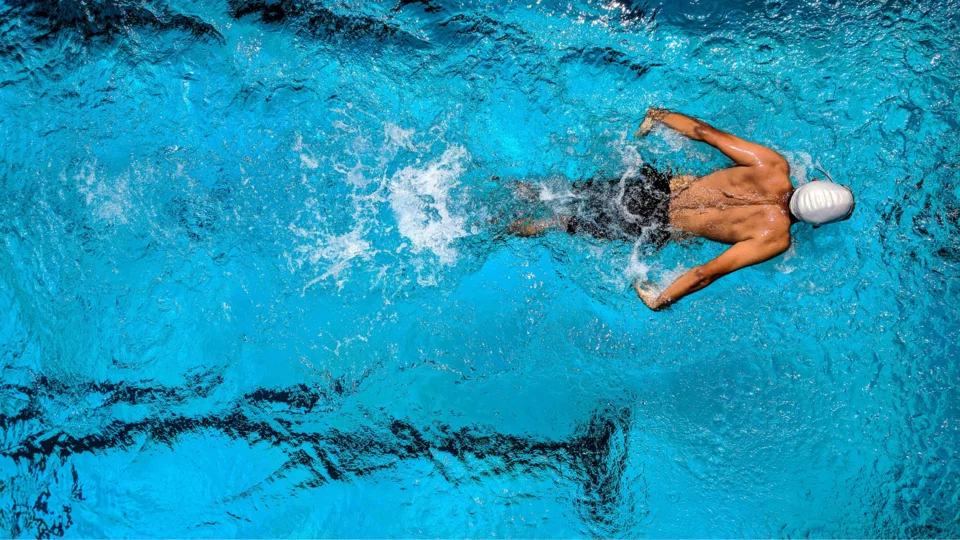
Monaco has three public swimming pools open to everyone, with no residency requirement: the Stade Nautique Rainier III and its 50-by-20-metre seawater pool heated to 27 °C on Port Hercule, the Saint-Charles indoor pool, reopened on 19 January 2026 after renovation, and the Centre Nautique Prince Albert II at the Stade Louis II, with its Olympic pool.
Few territories of 2.08 km² can line up two 50-metre pools, a neighbourhood indoor pool, a redesigned public beach and some of the most photographed hotel pools in Europe. Swimming holds a singular place in Monaco: it is at once a fully assumed public service, a sporting tradition and an art of living.
That tradition is embodied all the way up to the Prince's Palace: before becoming sovereign, Princess Charlene of Monaco was an elite swimmer, an Olympian in Sydney in 2000 in South African colours, and her Foundation has worked since 2012 to teach swimming and prevent drowning across the world. It would be hard to find a state where swimming is so deeply a matter of identity.
This guide reviews each pool, with its dimensions, prices and season, and extends our panorama of sport and wellness in Monaco, of which swimming is arguably the most democratic discipline.
Three public pools, the sea and exceptional private pools: the essentials in figures before diving into the detail.
Petrini tip: in a market where the private pool is the exception, proximity to a quality public pool is a location criterion in its own right; a residence with a pool of its own, meanwhile, trades as a rarity.
Swimming in Monaco happens in three public facilities, the Stade Nautique Rainier III, the Saint-Charles pool and the Centre Nautique Prince Albert II, complemented by sea swimming at Larvotto. This public offering often surprises our international clients: in the popular imagination, the Principality is a land of private clubs; in reality, the Mairie de Monaco runs pools open to everyone, at prices that are anything but Monegasque in the usual sense of the word.
Each of these pools nonetheless has its own personality and its own season, and that is precisely what structures the Monegasque swimmer's year: outdoor seawater in summer, the indoor pool in winter, the Olympic complex for year-round athletes. Let us begin with the most spectacular of the three.
The Stade Nautique Rainier III is Monaco's emblematic swimming pool: an open-air pool of 50 metres by 20, filled with seawater and heated to 27 °C, set on the inner basin of Port Hercule facing the yachts. The facility is not limited to lap swimming: a 45-metre waterslide, diving boards at 1, 3 and 5 metres, aqua-aerobics and aqua-biking classes and sun loungers for hire make it a true summer living space, as popular with families as with early-morning swimmers.
The season runs from early May to early October; in 2025, the pool opened on 6 May and closed on 8 October, with an interlude imposed by the most Monegasque calendar there is: the Formula 1 Grand Prix, whose circuit runs so close to the facility that the neighbouring chicane officially bears the name of the Piscine corner. As for prices, the Mairie's 2025 list set adult entry at 6 € for residents and those employed in the Principality, 4.50 € for ages 3-17, double for visitors, with free entry for children under 3 and for senior residents. Come winter, water gives way to ice: the pool turns into an open-air skating rink, one of Monaco's best-known seasonal images. Which leaves one question: where do the Monegasques swim from November to April?
The answer comes down to one name: Saint-Charles. This indoor pool, tucked into the heart of Monte-Carlo, is the regulars' pool, the one where people swim all year round in water kept between 28 and 32 °C. Its format of 18 metres by 12 has no Olympic ambition; it does something else, and does it well: swimming lanes, aqua-aerobics, classes for baby swimmers and seniors alike, in a neighbourhood atmosphere that residents appreciate precisely because it bears no resemblance to the Principality's postcard image.
The facility has, moreover, just emerged from a thorough refresh: after six months of works covering the complete renewal of the water and air treatment and heating systems, the pool reopened on 19 January 2026. Entry remains at 5 €, with a 10-entry card at 45 € and a 20-entry card at 85 €, free of charge for the very young and for residents over 60. An insider's detail: a swimming cap is compulsory. For serious long-course swimming, however, you must head down to Fontvieille.
The Centre Nautique Prince Albert II, part of the Stade Louis II, is Monaco's reference facility for competitive swimming: a 50-metre Olympic pool, a learners' pool and a diving pit, renovated and reopened in 2023. This is where the Principality's clubs train, from water polo to artistic swimming to freediving, a discipline Monaco has made a speciality of with record holder Pierre Frolla.
For a resident of Fontvieille, this centre is a luxury of proximity: a true indoor 50-metre pool a few minutes' walk away, something many major cities cannot offer. This sporting neighbourhood also plays its part in the district's residential appeal, which we discuss further below. But before stepping into the buildings, a detour is in order via Monaco's largest swimming pool: the Mediterranean.
Sea swimming is free and open to all at the Larvotto public beach, entirely redesigned in 2021 as part of the seafront transformation. A sheltered cove, supervised waters in season, shops and restaurants along the beachfront: Larvotto concentrates the Monegasque summer into a few hundred metres, within walking distance of the Thermes Marins and the great residences of Avenue Princesse Grace.
Regular swimmers settle into their habits here from spring onwards, and some coaches hold their open-water sessions at daybreak; it is, in fact, one of the favourite grounds of those who want to train with a personal coach in Monaco. The sea thus forms the link between public sport and the private world of wellness, where Monaco plays in a category of its own.
On the private side, Monaco lines up pools the whole world photographs. The Monte-Carlo Bay unfurls its sand-bottom lagoon of 100 metres, open from mid-May to the end of September; the Monte-Carlo Beach heats its Olympic pool to 28 °C from spring onwards; and the Thermes Marins Monte-Carlo offer swimming in its wellness form, built around heated seawater, tailor-made sport and recovery. These addresses follow a different logic from the municipal pools, that of the exceptional day out or the wellness membership, and they complete an aquatic palette few cities can offer across such a surface.
Monaco's leading gyms and fitness clubs belong to the same ecosystem, in the image of the Thermes Marins, where training floors and seawater pools answer one another within a single establishment.
This culture of wellness through water extends naturally to the gentle strengthening disciplines gaining ground in the Principality, first among them reformer Pilates in Monaco. And it inevitably ends up meeting the property question.
Monaco's swimming pools at a glance
Petrini summary, July 2026. Sources: Mairie de Monaco, 2025-2026 season price lists.
| Pool | Dimensions / water | District | Season | Entry |
|---|---|---|---|---|
| Stade Nautique Rainier III | 50 x 20 m, seawater 27 °C | Port Hercule | May to October (ice rink in winter) | 6 € residents / 12 € |
| Saint-Charles | 18 x 12 m, indoor, 28-32 °C | Monte-Carlo | Year-round | 5 € (cards 45 € / 85 €) |
| Centre Nautique Prince Albert II | Olympic 50 m + diving pit | Fontvieille | Year-round | Clubs / public sessions |
| Larvotto beach | Sea, sheltered cove (redesigned 2021) | Larvotto | Supervised in season | Free |
| Monte-Carlo Bay / Thermes Marins | Lagoon 100 m / wellness pools | Larvotto / Monte-Carlo | Mid-May to Sept. / year-round | Day pass / spa |
Table by Petrini Exclusive Real Estate Monaco. Prices taken from the list published by the Mairie de Monaco for the 2025 season and the 2026 reopening of Saint-Charles; detailed opening hours available from each facility.
Swimming in Monaco costs 6 €, not 600
The notion that everything in Monaco commands a premium does not survive the pool test: 6 € for resident entry to a 50-metre seawater pool overlooking Port Hercule, 5 € for the indoor pool in Monte-Carlo, 0 € for a swim at Larvotto. By way of comparison, these prices are in the same range as those of municipal pools in Paris or Nice, for facilities whose upkeep and setting have few equivalents.
It is something we regularly observe with clients relocating to Monaco: everyday Monegasque life, pools included, is often more affordable than its reputation suggests. Monaco's real cost lies elsewhere, in housing; the water, for its part, remains democratic.
On the Monegasque property market, the residence pool is the exception that creates value, and our agency sees it single-handedly drive certain choices of address: some clients settle on a building first and foremost for its pool. The density of the territory makes such facilities structurally rare, and their mere presence places a property, at comparable size and address, at the top of the price range.
Among outdoor pools, the benchmark is the Parc Saint Roman, whose 33-metre pool with snack bar is the largest residence pool in the Principality. Then come the open-air pools facing the sea at the Mona residence and the Monte-Carlo Sun, the pool of the Terrasses du Port and, in Fontvieille, those of the Grand Large, the Monte Marina and the Paradise.
Winter swimmers, for their part, look to the indoor pools: the Park Palace, the 26 Carré d'Or, La Petite Afrique, the Monte Carlo Star and the Tour Odéon offer covered pools, often adjoining a spa or a private gym, the amenity most requested by our international clientele.
Then comes the ultimate degree: a pool of one's own. A handful of Monegasque apartments feature a private pool or a terrace jacuzzi, and these properties rarely circulate as listings: this is typically the segment where our off-market offers make the difference, and where a dedicated search with our agency opens doors that are advertised nowhere.
The geography of the public pools also weighs in residential trade-offs: Fontvieille with its Olympic centre, the Port with its nautical stadium, Larvotto with its beach each attract their own profile of swimmer. A stone's throw from the sand, the apartments of the Larvotto district illustrate that front-row-to-the-sea premium. This is the kind of reading, facilities, orientation, actual use, that our building-by-building knowledge brings to a search, well beyond the floor area and storey of a listing.