Alessandro
Ossola
Ossola
Négociateur
WhatsApp
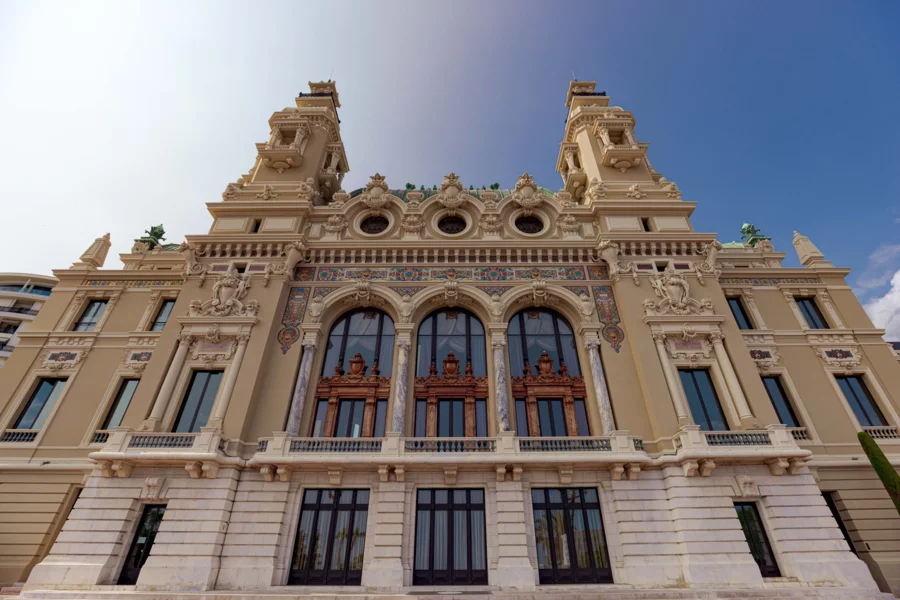
The Casino de Monte-Carlo is one of the most famous gaming establishments in the world: inaugurated in 1863 under the reign of Charles III and operated from the outset by the Société des Bains de Mer, it gave birth to the district that today bears the name Monte-Carlo.
Before it, the Spélugues plateau was little more than a barren promontory overlooking the sea. Within a decade, this vantage point had become the gravitational center of the Monte-Carlo district and a global symbol of a certain art of living. This guide tells how a political gamble in 1863 founded an economic model, an architecture and a real estate market without equivalent, and provides all the practical information needed to visit the monument in 2026.
The Casino de Monte-Carlo sums up Monaco's economic history in a single building. Here are the essential facts, verified against official sources.
Petrini tip: visit the monument in the morning for the architecture, come back after 7 pm for the atmosphere of the gaming rooms. The games open from 2 pm, smart dress required.
The Casino de Monte-Carlo is at once a gaming establishment, a Belle Époque monument and a public asset. It belongs to the Société des Bains de Mer et du Cercle des Étrangers à Monaco, the SBM, a company listed on Euronext Paris of which the Monégasque State holds 64.21% of the capital, a figure published by the group in its financial statements. Every chip wagered in its rooms therefore indirectly feeds the budget of a sovereign State.
This singularity has no equivalent. Monaco was a fully-fledged country long before the casino was created, but it was the casino that gave it the means for its economic independence. Understanding this building means understanding why the Principality works the way it does.
The casino was born out of a territorial amputation. In 1860, the cession of Menton and Roquebrune stripped Monaco of most of its land and inhabitants, in proportions that historical research puts at around 93% of its territory and 85% of its population. The Principality of Monaco was reduced to a coastal strip with no agricultural resources, and its sovereign had to invent an economic model from almost nothing.
Charles III staked his bet on gaming and resort tourism. A first concession was granted as early as 1856, without lasting success: concessionaires came and went, each one failing. Everything changed on 2 April 1863, when operations were entrusted to François Blanc. The man was no adventurer: since 1840, he and his brother had run the Homburg gaming house in Germany, opened on 23 May 1841 and by then one of the most popular in Europe. Blanc knew exactly what he had come to Monaco to do.
The contract was unusually ambitious. In exchange for the monopoly, the Société des Bains de Mer had to provide the Principality's public services: water and gas supply, road construction, land and sea transport to Nice and Menton, even publication of the official gazette, according to the Prince's Government. The casino was not entertainment bolted onto an existing town: the town was built around the casino, by its operator.
Success came quickly. On 1 June 1866, Charles III lent his name to the Spélugues plateau, henceforth Monte-Carlo, Charles's Mount. The event marked a turning point in the line of Princes of Monaco, none of whom had yet attached his name to a new town. Three years later, in 1869, the windfall from gaming allowed the Prince to abolish direct taxes for his subjects. The founding principle of Monaco's tax appeal, still in force today, was born in the casino's gaming rooms.
After François Blanc's death in 1877, his wife Marie Blanc carried on his work and thought even bigger. Until then, the history of the Rock of Monaco had been written around the palace and the port; it was she who permanently shifted the Principality's social center of gravity to the plateau opposite, entrusting an already famous architect with transforming the casino into a palace.
The Casino de Monte-Carlo owes a decisive part of its destiny to the railway. Before 1868, the Principality could only be reached by sea or by mule tracks: a luxury casino there was a difficult promise to keep. On 19 October 1868, the Nice-to-Monaco line opened, and the Journal de Monaco reported that, despite pouring rain, this first day brought 346 travelers into the Principality, with four trains now serving the station each day.
The figure looks modest; in reality, it was the tipping point. The SBM was already announcing more than 170,000 tourists welcomed in 1869, the following year. The railway turned a geographical curiosity into a stay-worthy destination for European aristocracy, and accessibility became Monaco's foremost asset, well before its decor.
This founding lesson has never stopped being applied: the Principality later buried its own railway line to reclaim the freed-up land, and has never stopped gaining ground from the sea. The surface area of Monaco, today 208 hectares, remains the parameter that governs its entire economy.
The architect of the Paris Opera designed the most spectacular part of the monument. In 1878, the original buildings were demolished and Charles Garnier designed the performance hall, inaugurated on 25 January 1879 with Sarah Bernhardt on stage: the Salle Garnier, home of the Opéra de Monte-Carlo, 517 seats according to the Monégasque tourist office, nestled in the south wing of the casino facing the sea.
The rest of the monument was built up in layers, as the SBM details: the atrium with its 28 marble columns in 1879 by architect Dutrou, the Salle des Amériques designed by Garnier in 1881, the twin Salles Touzet in 1890, the Salle Blanche and Salon Rose in 1903, the monumental Salle Médecin in 1910. Half a century of almost uninterrupted building work, paced by the expansions that success demanded.
The greenery was designed alongside the stonework. As early as 1879, Charles III entrusted the design of the square's gardens to landscaper and botanist Édouard André, with an instruction that has become famous: to offer winter visitors an eternal spring from December to March. Since 2014, the Boulingrins gardens have housed five pavilions covering 2,700 sqm that carry on this tradition of hospitality.
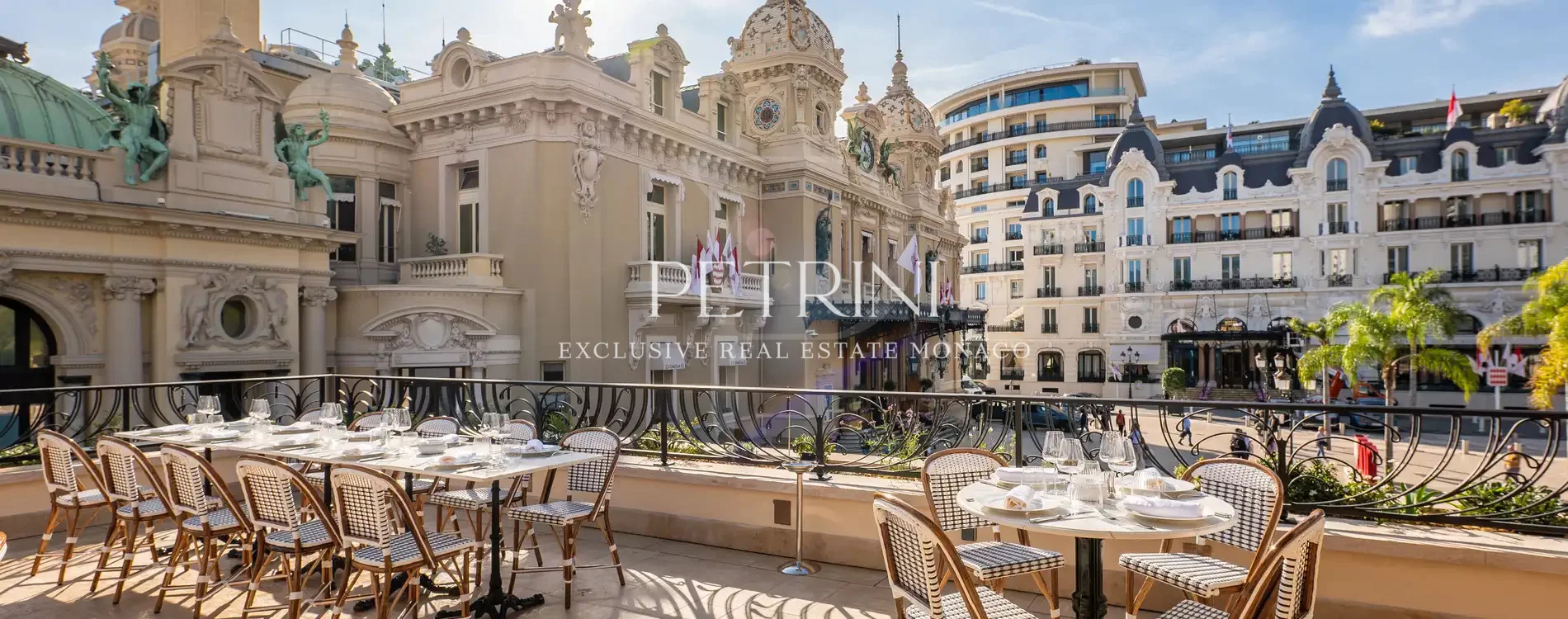
The dialogue with the square is just as carefully considered. Facing the casino, the Hôtel de Paris, inaugurated as early as 1864, was conceived by François Blanc as the finest hotel in Europe; for a hundred and sixty years, the casino, the palace and the Café de Paris have formed the most photographed trio on the Côte d'Azur.
Nor has the building ever been merely a gaming house. Its performance hall has hosted world premieres that matter in the history of music, from Massenet's Le Jongleur de Notre-Dame in 1902 to Ravel's L'Enfant et les Sortilèges, with a libretto by Colette, premiered on 21 March 1925. Serge de Diaghilev's Ballets Russes settled there from 1911, with sets by Picasso, Matisse and Braque, until their final performance on 9 May 1929. The Ballets de Monte-Carlo, founded in 1985 at the initiative of the Princess of Hanover to fulfil a wish of Princess Grace, carry on this legacy.
Here are the dates that shaped the monument, all drawn from the official chronologies of the SBM, the Journal de Monaco and the Prince's Government.
The dates that shaped the Casino de Monte-Carlo
Sources: Société des Bains de Mer (official chronology), Journal de Monaco, Prince's Government and Legimonaco.
| Year | Event |
|---|---|
| 1860 | The cession of Menton and Roquebrune deprives Monaco of most of its territory and population |
| 1863 | The casino opens; François Blanc obtains the concession and founds the Société des Bains de Mer |
| 1864 | Inauguration of the Hôtel de Paris, conceived as the finest hotel in Europe |
| 1866 | The Spélugues plateau becomes Monte-Carlo by ordinance of 1 June |
| 1868 | Opening of the Nice-to-Monaco railway on 19 October: 346 travelers on the first day |
| 1869 | Charles III abolishes direct taxes; more than 170,000 tourists welcomed over the year |
| 1879 | Inauguration of the Salle Garnier on 25 January; the square's gardens designed by Édouard André |
| 1881-1910 | Salle des Amériques (1881), Salles Touzet (1890), Salle Blanche and Salon Rose (1903), Salle Médecin (1910) |
| 1911 | Diaghilev's Ballets Russes settle in Monte-Carlo, sets by Picasso, Matisse and Braque |
| 1966 | The law n° 807 of 23 June brings the Monégasque State into the capital of the Société des Bains de Mer |
| 1987 | Law n° 1.103 of 12 June sets the gaming regime, including the ban on Monégasque nationals |
| 2020 | Inauguration of the new Casino Square, redesigned by Michel Desvigne, on 2 June |
Table by Petrini Exclusive Real Estate Monaco. Chronology compiled from the official publications of the SBM, the Journal de Monaco and the Prince's Government.
Monégasque citizens cannot gamble at the Casino de Monte-Carlo, and this ban is written into law. Article 11 of law n° 1.103 of 12 June 1987 on games of chance provides that Monégasque nationals, like civil servants and agents of the State, the Commune and public bodies, may not take part in games in the Principality's gaming houses.
The logic is old and clear: the games exist to capture spending from foreign visitors, never to impoverish nationals. The SBM's full name, Société des Bains de Mer et du Cercle des Étrangers, has said exactly that since 1863. The same law also restricts access to the rooms to adults and allows barred individuals, uniformed military personnel or ministers of religion to be turned away.
For a foreign resident of Monaco, however, there is no such ban: gambling remains perfectly legal. It is one of the rare privileges that Monégasque citizenship takes away rather than grants.
The casino can be visited in two ways: as a heritage visitor in the morning, as a gambler in the afternoon and evening. The gaming rooms open every day at 2 pm; entry costs €20, of which €10 can be used on-site, at the slot machines, the bar or the Salon Rose, according to the SBM's official ticketing terms. Access is reserved for those aged 18 and over, on presentation of an original identity document: a national ID card for European Union nationals or a passport, with copies and digital documents refused.
In the morning, the monument opens to visitors who want to see the atrium, the historic rooms and the artworks without gambling, with last entry at 12:15 pm. The dress code is real but reasonable: shorts, sportswear, sneakers and beachwear are turned away from the afternoon onward, t-shirts after 7 pm, and a jacket is required in the evening in the Salons Privés. A well-dressed visitor is never turned away; a gambler in flip-flops, always.
Visiting the Casino de Monte-Carlo: the essentials for 2026
Source: montecarlosbm.com, entry conditions checked in August 2026. Information subject to change, please verify before your visit.
| Information | Detail |
|---|---|
| Gaming rooms | Every day from 2 pm; slot machines in the Salle des Amériques from 11 am |
| Gaming entry fee | €20, including €10 usable on-site (slot machines, bar or Salon Rose) |
| Heritage visit | In the morning, last entry at 12:15 pm |
| Requirements | 18 years and over, original identity document required |
| Dress code | Smart attire; shorts, sportswear and sneakers not permitted; jacket required in the evening in the Salons Privés |
| Rooms to see | Atrium, Salle Europe, Salles Touzet, Salle Blanche, Salle Médecin, Salon Rose |
Table by Petrini Exclusive Real Estate Monaco, based on the conditions published by the Société des Bains de Mer.
The casino cultivates traditional European games, where Las Vegas standardized its own. French roulette and English roulette, trente et quarante, blackjack, baccarat, Punto Banco and Ultimate Texas Hold'em share the rooms, with minimum stakes posted from €5 at the roulette tables. Slot machines, spread notably through the Salle des Amériques, round out the offering from late morning.
The presence of roulette alone explains part of the myth. When France once again authorized gambling in the casinos of classified resorts, under the law of 15 June 1907, it expressly excluded roulette and trente et quarante: for decades, one therefore had to cross the Monégasque border to play them legally on the Riviera. Monte-Carlo did not merely have a head start, it long held exclusivity over the most romantic games.
A detail few visitors know: the gaming tables are made in the SBM's own workshops, an in-house craft tradition that reflects the care given to the decor. The Salons Privés, accessible by dress and by custom, in turn carry on the great tradition of the closed circles of the 19th century.
The Casino de Monte-Carlo belongs to the Société des Bains de Mer, controlled by the Monégasque State, which holds 64.21% of its capital according to the group's disclosures. This public ownership was anything but a historical given: it resulted from a power struggle that remains famous in the Principality.
In the 1950s, Greek shipping magnate Aristotle Onassis effectively took control of the SBM by becoming its principal shareholder. The situation became untenable: the country's leading employer, owner of the national monument, was slipping beyond the State's control. Prince Rainier III responded with the law. Law n° 807 of 23 June 1966, published in the Journal de Monaco, created 600,000 new shares allocated to the State and gave it the right to buy back existing shares. The company challenged the law before the Supreme Court, which rejected its appeal on 6 March 1967. Onassis sold his stake and left the game.
Since then, control of the casino has never again been in question. The SBM is today the Principality's leading private employer, operating, beyond the Casino de Monte-Carlo, the Casino Café de Paris, legendary hotels and more than thirty restaurants and bars. With the 2026 Michelin Guide, the group claims the title of most-starred resort in the world, with 10 stars spread across six restaurants.
The group has also become a leading landlord. In the financial year ended 31 March 2026, the rental division accounted for 156.5 million euros in revenue, or 18% of the group's total, of which 62.7 million came from residential rentals alone, with an occupancy rate close to 100%. In other words, the company founded to run a gaming house today draws nearly a fifth of its revenue from Monégasque real estate.
It continues, moreover, to shape the district. After delivering One Monte-Carlo, the SBM is carrying a real estate project on the Terrasses du Casino, which it calls Thermes-Terrasses and which the press has nicknamed One Monte-Carlo 2 by analogy with its predecessor. The program, presented by the group's management to the Monégasque press and not yet detailed in its financial communications, would reportedly include around ten ultra-luxury residences, offices, shops and a fully rebuilt Thermes Marins, with construction hoped to start in 2027. A new, profound transformation of the casino's surroundings is therefore in the works, subject to authorization.
Monaco no longer lives off gambling, and the gap with the popular image is striking. In 2025, Monégasque State revenue stood at 2,464.7 million euros, of which 62.6 million came under licensed monopolies, the category the Société des Bains de Mer falls under: that is 2.5% of the total, according to IMSEE. The share attributable to gambling alone is even smaller, as this budget line covers other concessions too.
It is now indirect taxation and the services economy that fund the Principality: VAT and commercial transactions alone account for 1,239.1 million euros, half of State revenue. At the SBM group's own level, the trend is the same: in the financial year ended 31 March 2026, gaming accounted for 259.6 million euros in revenue against 443.1 million for hospitality.
What the casino really brings to Monaco is no longer gambling money
The idea that the Principality lives off the green baize is a shortcut that stopped being accurate decades ago. The public figures show it unambiguously: licensed monopolies account for 2.5% of State revenue in 2025, while VAT alone provides half of it.
This figure must be read correctly: it is not that gaming has lost its importance, it is that Monaco's economy has diversified around it. The casino remains an essential piece of that economy, and the symbol on which the Principality's appeal rests. The SBM itself is proof of this: it now draws 18% of its revenue from rentals, a real estate activity that would not exist without the address value created by the monument.
The casino's real contribution has therefore become indirect, and it is considerable: it manufactures the reputation that attracts residents, businesses and visitors. In 2025, Monaco recorded nearly 6.7 million visits for around 1.4 billion euros in direct spending, according to the IMSEE and Tourism Department survey.
For an observer of the real estate market, the reading is simple: the casino no longer weighs on the State budget, it weighs on the value of the addresses around it. A hundred and sixty years of reputation is not built twice, and it cannot be relocated.
The legend of the place was written early on. In 1891, Englishman Charles Wells strung together winning streaks at roulette to the point of breaking the bank several times over, according to contemporary accounts: the tables had to be covered with a black cloth while their reserves were replenished. The feat inspired a music-hall song that remains famous, The Man Who Broke the Bank at Monte Carlo, before Wells ended up convicted of fraud. The myth, however, was launched.
Cinema did the rest. James Bond made it home from Never Say Never Again to GoldenEye, and the casino regularly serves as a backdrop or reference, from Ocean's Twelve to Madagascar 3. Few buildings in the world have fed the imagination of luxury so much, and this image feeds directly into the residential appeal of a 2.08 km² territory.
In summer, moreover, the legend is lived as much outdoors as indoors. The evenings at Maona Monte-Carlo carry the atmosphere of the gaming rooms late into the night, for a clientele that comes to Monaco looking for exactly what the casino invented: the permanent spectacle.
The same spirit reaches down to the shore. Days at the Monte-Carlo Beach Club belong to the same universe, that of a principality where luxury is lived outdoors, from the beach to the terraces of Casino Square.
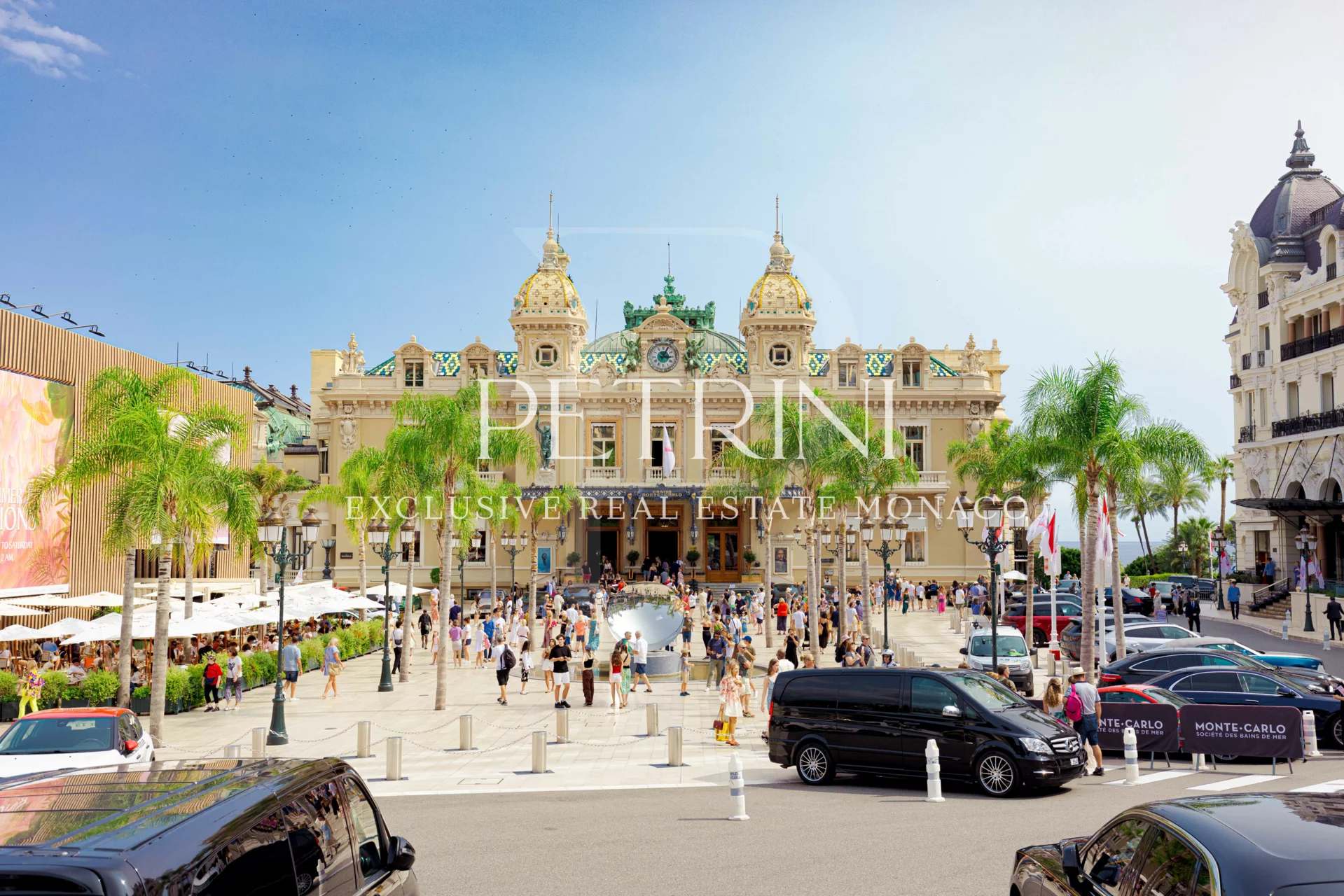
Around the monument stretches Monaco's most coveted residential area. The square itself was entirely redesigned by landscaper Michel Desvigne and inaugurated on 2 June 2020 in the presence of Prince Albert II: a pedestrian, stone-paved esplanade around Anish Kapoor's Sky Mirror, which preserves the layout of the Monaco Formula 1 Grand Prix, whose Casino corner remains one of the most-filmed sections of the championship.
The real estate transformation followed the same timeline. On the site of the former Sporting d'Hiver, the One Monte-Carlo complex, delivered in 2019 by the SBM with architects Rogers Stirk Harbour + Partners and Alexandre Giraldi, added 37 apartments and a new shopping promenade just steps from the gaming tables.
The historic trio was renovated in the same wave: the Hôtel de Paris reopened entirely transformed in January 2019 after four years of work, and the reopening of the Café de Paris in November 2023 completed the square's new face. In under ten years, the SBM has rebuilt the equivalent of an entire district around the casino, without ever closing the monument. This wholesale renovation has lifted the standing of the entire area, and the complete refurbishment of the Hôtel de Paris has put the palace back in the running with the world's greatest.
This instinct for reclaiming land is Monégasque before it is a real estate matter. It is the same logic that led to burying the railway line: the Monte-Carlo station, which occupied the site of today's Fairmont, closed in 1965 after the new route was cut, and putting the line underground, completed in 1999, freed up four hectares in the heart of the center. In Monaco, every square meter returned to the city immediately becomes an asset, as also shown by Mareterra, the world's most expensive district, inaugurated on 4 December 2024.
What remains is to understand what this centrality means for someone looking to settle here. On the scale of the Principality, the casino is not just a monument: it is the landmark from which newcomers organize their entire reading of the city. When a client discovers Monaco, they instinctively place what they are visiting in relation to the casino, and their first question is almost always about what can be found to live in nearby.
One clarification is needed here, as it is often misunderstood from the outside: the Carré d'Or is not an administrative district of Monaco. It is a sub-area of the Monte-Carlo district, a handful of streets around Casino Square where the luxury boutiques and the most prestigious residences are concentrated. The apartments for sale in the Carré d'Or belong to this restricted area, and it is this very scarcity that drives the price.
A word, however, on a stubborn misconception. Nobody buys in Monaco for the myth of the casino: I have never seen a buyer choose an apartment because a roulette wheel is spinning across the street. What the wealthiest clients come looking for in the Carré d'Or is the centrality and the glamour of the Principality's best-known spot, with the boutiques, the palaces and the services just steps away. The casino is not the selling point, it is the center of gravity.
Several Monégasque residences offer a direct view of the Casino de Monte-Carlo, and it is a recurring request from our clients: some buyers insist on seeing the monument from home. Here are the ones we mention most often during viewings, along with what sets each apart.
For the postcard view, quite literally, Les Floralies offers one of the finest views of the casino and the square, in a building right in the heart of the Carré d'Or.
The Mirabeau offers spectacular views of the casino from its upper floors, with the added benefit of a historic address firmly established on the Monégasque market.
Just steps away, Park Palace remains one of the most sought-after residences in the area, valued for its location and the quality of its common areas.
At Le Métropole, it is the upper floors that offer the view, with direct access to the shopping center and luxury boutiques at street level.
Our own offices occupy the ground floor of the Prince de Galles, right in the Carré d'Or, whose rooftop overlooks Casino Square. The entrance is deliberately discreet, known only to insiders: it is a deliberate choice, that of bespoke, confidential service, with no street-facing shopfront, which our name, Exclusive Real Estate, reflects literally. Our clients naturally associate us with this area, which we work in every day.
To this list should be added Sun Tower, along with La Petite Afrique, the Palais Saint James and Le Montaigne, which round out the area's offering. Even Le Renzo, in Mareterra, enjoys a fine view of the casino, proof that the monument remains the focal point of the Monégasque coastline.
The case of One Monte-Carlo is different. It is not the view being bought there, but a level of service that few addresses in the world can offer: access to the Thermes Marins Monte-Carlo, hotel-style services from the Hôtel de Paris, valet parking. It is ultra-luxury in the strictest sense, and it explains the very strong rental demand we see there.
The Carré d'Or is a residents' address, not just a backdrop for visitors. The district was, admittedly, created for tourism, and that is even its historical birth certificate, but the offering that today surrounds Casino Square is used extensively by those who live there.
Residents dine there all year round. Alain Ducasse's Le Louis XV, at the Hôtel de Paris, holds three stars in the 2026 Michelin Guide; Le Grill, on the eighth floor of the same palace under its retractable roof, holds one; the Amazónico rooftop, opened in April 2024 above the Café de Paris, found its local clientele immediately. All of this SBM offering around the casino is part of daily life for those who live in the area.
The comparison that speaks best to our international clients is with the great capitals: the Carré d'Or is to Monaco what the area around Central Park is to Manhattan, a dense, lively nerve center, sought after precisely for that reason. The crowds and the buzz are not a flaw of the product, they are part of it.
Should this be seen as a nuisance, though? No, and it is an objection I hear regularly. Living opposite the casino is not about enduring a flow of tourists, it is about living within a particular atmosphere and way of life, with a magnificent historic building in view. Many clients are looking for exactly that.
This obviously does not suit everyone, and it is our role to say so. Buyers who want absolute calm head toward Larvotto or Fontvieille, where the atmosphere is entirely different, just minutes away. The choice between these two faces of Monaco is often the real question in a search, well before budget.
The Carré d'Or commands a premium of 20 to 35% more than the rest of Monte-Carlo, according to our agency's observations, and the gap exceeds this range for exceptional properties. On the rarest typologies, fully renovated large surfaces, sea view, high floors, parking and residence concierge, transactions observed in buildings such as Le Mirabeau, Les Floralies or Park Palace can reach €100,000 per square meter.
Where these figures come from
The 20 to 35% gap and the €100,000 per square meter level are drawn from transactions and mandates observed by Petrini Exclusive Real Estate Monaco within the Carré d'Or, cross-checked against public IMSEE data. They describe exceptional properties, not the everyday market.
These figures are approximate benchmarks meant to help gauge a budget. They constitute neither a professional appraisal, nor a binding valuation, nor a price commitment: each property is valued according to its floor, surface area, condition, ancillary spaces and the co-ownership regulations.
To place these levels within the overall market, our analysis of price per sqm in Monaco breaks down values district by district; the casino area occupies, year after year, the very top of the hierarchy.
Recent dynamics confirm this ranking, as shown by Monégasque real estate market trends: scarcity is priced first at the center.
The profile of buyers, however, has changed. Today's buyers are increasingly young business owners, of every nationality, who come for a range of reasons of which taxation is just one component: security, quality of life, climate, the standard of services and healthcare, and a central position in Europe while remaining outside the European Union. The Carré d'Or remains a genuine melting pot of cultures, with no single nationality dominating.
This heart of prestige, moreover, has a name of its own with us. The area our agency has defined as the Billionaires' Triangle is built precisely around Casino Square: it is the zone where the monument's history, land scarcity and international demand overlap.
This is where the choice of advisor makes the difference. We work this area building by building, with the memory of residences, floors and transactions that lets us distinguish, opposite the casino, the legendary address from the merely well-placed one. Two apartments three floors apart in the same building are not worth the same price, and it is precisely that kind of gap that plays out at the negotiating table.
A century and a half after it opened, the Casino de Monte-Carlo is no longer Monaco's source of revenue: the public figures say so, and the Principality has long welcomed the fact. Yet it remains its most precious possession, the building that made everything possible, from the abolition of direct taxes in 1869 to today's skyline. Visitors see a cinematic backdrop; residents know they live in the city that backdrop literally created. And for as long as the roulette wheel keeps turning in the Salle Europe, Monaco's center of gravity will remain exactly where Charles III placed it in 1863.