Mareterra Monaco: One Year After the Inauguration – Assessment
Publié le 18/12/2025
Temps de lecture
12
min.
Places and discoveries
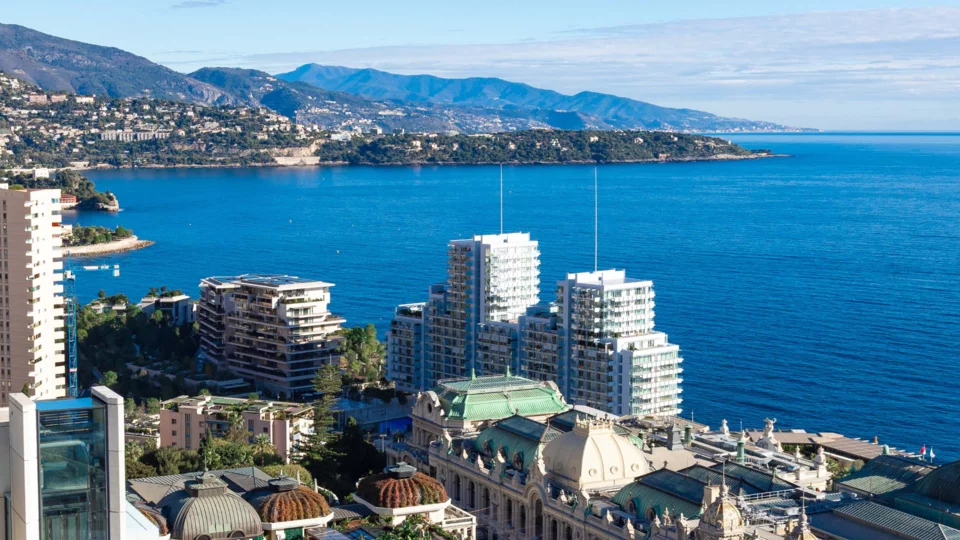
One year after its inauguration, Mareterra has established itself as a structuring urban project for Monaco. It generates strong economic value creation, redefines the benchmarks for ultra‑prime real estate and strengthens the Principality’s international reach, all while meeting environmental and urban‑use commitments.
Discover our selection of apartments
for sale in Monaco
for sale in Monaco
Studios, one- to five-bedroom apartments, penthouses and prestigious properties
Fully pedestrianised and HQE/BREEAM certified, Mareterra has quickly found its place in everyday life in Monaco: sea‑front promenades, lush gardens, public art works and ultra‑prime residences now coexist in this unique district where the price per square metre exceeds €100,000. A year after it opened, has Mareterra lived up to its promises in terms of urban planning, the economy and international influence? Discover how these six pioneering hectares have changed the Principality and what lies ahead for 2026.
A sustainable district that has become a true place to live in Monaco
From its first year, Mareterra became a fully integrated district in Monegasque life. About 50 % of the six hectares are accessible to the public, with a one‑hectare landscaped park, 750 metres of coastal walkway and a network of pedestrian spaces without car traffic – a rarity in the Principality.
Update January 2026
Mareterra Monaco: Essential Highlights
One year after its inauguration, Mareterra stands as a structuring urban project for Monaco, combining significant economic value creation, a new ultra‑prime real estate benchmark and real urban uses, all while reinforcing the Principality’s international reach and honouring its environmental commitments.
Analysis by Petrini Exclusive Real Estate Monaco · public data & on‑the‑ground observations
+€1.2 billion
Estimated cumulative tax revenue (VAT & duties), a significant budgetary lever for the Monegasque state
€120,000 / m²
New global price benchmark, cited by the Financial Times for the Larvotto–Mareterra sector
300 to 1,500 m²
Large family apartments fulfilling a structural need previously absent in Monaco
Lived‑in district
Public spaces, culture and shops: Mareterra functions as a piece of city
Conceived as a benchmark eco‑district, Mareterra combines high urban quality of life with environmental performance. The site includes 9,000 m² of solar panels, sea‑water heat pumps and a rainwater recovery system, while fostering terrestrial and marine biodiversity. Ecologically, the project represents a turning point.
The transplantation of 500 m² of Posidonia seagrass undertaken as part of the land reclamation project is now considered a scientific success, enhancing Monaco’s international recognition in marine conservation. On land, more than 1,000 Mediterranean trees and shrubs were planted, making Mareterra one of the greenest neighbourhoods in the city as it matures.
Mareterra Monaco: Insights from the First Year
One year after its inauguration, Mareterra can now be assessed based on observable facts rather than projections. This first year allows us to analyse what the land reclamation has actually produced for Monaco: economic value creation, residential attractiveness, concrete uses of the district, environmental credibility and impact on the Principality’s international image. The following assessment is based on tangible results and observable dynamics, not intentions.
Economic value creation clearly observed
From its first year of existence, Mareterra generated documented economic benefits for the Principality. All residential units in the district were sold before completion, confirming the project’s appeal and the price levels achieved, with values exceeding €100,000 / m² for certain types. According to data reported by the Monaco Economic Board and cited in several specialised real estate analyses, the Mareterra project has already generated over €1.2 billion in cumulative tax revenues (VAT and registration duties) since construction began. Several properties have already been resold once or even twice; each transaction generates additional tax revenue for the state. Relative to Monaco’s GDP, now estimated by IMSEE at around €10 billion, this revenue illustrates the project’s real macroeconomic weight. Mareterra is therefore not simply a prestigious property ensemble; it is also an active budgetary lever whose effects reach beyond the district’s perimeter.
Residential appeal that goes beyond internal relocation
One major objective of the project was to avoid merely shifting existing residents around within the Principality. Initial observations indicate that a significant proportion of Mareterra’s occupants are new UHNW residents, attracted by very large units, an unprecedented living environment and amenities previously rare in Monaco.
Thus Mareterra addresses a structural residential need long limited by land scarcity: the availability of large family apartments. Apartments and villas range from 300 to over 1,000 m², allowing families with children to settle permanently under conditions comparable to those in major global cities. Historically, such formats were hard to find in Monaco, where the fragmented property stock limited access to large volumes. In this sense, Mareterra isn’t just an additional luxury; it is a functional answer to contemporary residential needs, particularly in a context where dwelling size directly affects how many people can obtain Monaco residency.
The Mareterra effect on Monaco’s real estate market
Beyond transactions within the district itself, Mareterra has already had a structuring effect on the entire Monaco property market. By establishing unprecedented price levels that the market quickly absorbed, the project set a new reference point for value, especially for properties in the immediate vicinity. This phenomenon is evident in the Larvotto sector, where comparisons with Mareterra have helped elevate the perception and valuation of existing assets, confirming a halo effect rather than simply shifting value. This dynamic has been directly observed in the field by the teams at Petrini Exclusive Real Estate Monaco, a long‑standing player in the market, through transactions and resales completed since the district opened.
Mareterra now serves as a benchmark asset in the decisions of ultra‑prime buyers, influencing not only prices but also the expected standards for space, amenities and urban environment. The project has not fragmented the market but instead raised the overall value ceiling, reinforcing Monaco’s position as a leading global real estate market.
— Eugenia Petrini, Founder of Petrini Exclusive Real Estate Monaco
A district genuinely used beyond its residents
Unlike some ultra‑premium projects that struggle to integrate into daily life, Mareterra quickly became part of local routines while achieving cultural relevance. Its promenades, gardens and pedestrian spaces – about half of which are open to the public – are regularly used by Monegasque residents and visitors. The Grotte Bleue, integrated within the maritime structures and allowing observation of underwater life, and the Meditation Space, designed by artist Tia-Thủy Nguyễn, are now full‑fledged visitor attractions beyond their symbolic significance.
This integration fits into a broader cultural framework: the Prince Jacques Promenade is designed as an open‑air route marked by art installations and viewpoints over the Mediterranean, while Alexander Calder’s monumental sculpture “Quatre Lances”, restored and installed in Princess Gabriella Square, gives the neighbourhood a heritage dimension that is rare for a contemporary project. This point is central: Mareterra is not merely a gated residential cluster but a piece of living city where art, architecture and landscaping are integral to the daily urban experience and the cultural identity of the Principality.
Environmental credibility: first results
From an environmental standpoint, the first year already allows us to compare the initial promises with observable results. The announced features — solar panels, sea‑water heat pumps, rainwater harvesting — are indeed operational. The Posidonia transplantation, monitored scientifically, is considered a success, while greening of the site is visible and effective. While a definitive environmental assessment will require more time, no significant gaps between promises and reality have emerged at this stage.
Real impact on Monaco’s image and international position
Finally, Mareterra has had a substantial, measurable effect on Monaco’s international image beyond its real estate dimension. The project received major international media coverage, particularly in the economic and financial press, where it was analysed as a unique example of controlled land‑reclamation combining marine engineering, high‑level urbanism and ultra‑premium positioning.
The Financial Times ranked the Larvotto–Mareterra area as the most expensive residential neighbourhood in the world, highlighting the project’s direct impact on global property value indicators and on Monaco’s positioning relative to markets like New York, London and Hong Kong. This recognition has put Monaco back at the centre of global discussions around land scarcity, sustainable luxury and the capacity of micro‑states to innovate without diluting value.
Through Mareterra, Monaco has delivered not just a new neighbourhood but a model of urban development observed, compared and discussed worldwide. The project is now cited as a reference point in debates on the coastal city of the future, sustainable luxury and strategic territory management, enhancing Monaco’s soft power and its image as a state capable of combining sovereignty, innovation and long‑term international appeal.
Commerce and strategic urban planning
What role does Mareterra play in Monaco’s commerce and urban planning one year after opening? Mareterra is progressively emerging as a new commercial and lifestyle hub, designed to rebalance Monaco’s urban organisation eastward and strengthen continuity between Larvotto and Monte‑Carlo. This strategy is based on a targeted ramp‑up of commercial offerings from 2026 onward, intended to generate daily foot traffic beyond residents. Several key tenants have been identified:
- Zéphyr: a festive Greek restaurant run by the Pachamama Group (already in Paris, London, Mykonos) offering high‑end Mediterranean cuisine and an international nightlife atmosphere.
- Angel Cakes: a tearoom and healthy patisserie from Dubai specialising in vegan and gluten‑free creations, aligning with the wellness and lifestyle positioning of the district.
- TAEX: a new‑generation gallery dedicated to digital art, immersive installations and NFTs, intended to extend Mareterra’s cultural and experimental dimension.
- Café Saddle: a premium café concept already established in Cannes, Saint‑Tropez, London and Paris, set to become a daily meeting place and social anchor point for the neighbourhood.
To these openings adds the planned ABC Co. concept store, oriented toward fashion, design and lifestyle objects, complementing the existing luxury retail offering. On a broader urban scale, the multifunctional complex above the Fairmont tunnel, named Neuehouse and designed to connect Mareterra with Monte‑Carlo, will house high‑end workspaces, cultural functions and a panoramic restaurant. This will consolidate Mareterra’s role as an active, frequented and structuring district within the Principality.
Mareterra: A signal to the future
Beyond its concrete results, Mareterra carries a strong symbolic dimension for Monaco. At the inauguration, Prince Albert II noted that no further extension of similar scale was planned, underscoring the project’s exceptional and non‑replicable nature. Yet the question Mareterra raises remains: how to manage territorial scarcity in a country whose attractiveness shows no sign of waning. Monaco remains one of the most coveted territories in the world, with structural residential and economic pressure and naturally limited space.
In the medium to long term, it is not unreasonable to wonder how future responses to this constraint might take shape if needed. Without anticipating any political decision, technological innovations and international discussions around artificial islands, floating structures or reversible maritime solutions open new possibilities, especially since offshore waters are part of Monaco’s territory. Mareterra thus appears not only as a completed achievement but as a signal to the future: a state capable of anticipating, innovating and, when the time comes, reimagining the boundaries of its development.
One year after its inauguration, Mareterra stands out as a structuring urban project for Monaco, combining significant economic value creation, a new ultra‑prime real estate benchmark and real urban uses. It strengthens the Principality’s international influence while respecting environmental commitments.
Author

Nos derniers biens disponibles
 9 800 000 €
Riviera Palace · Monte-Carlo
Exceptional apartment with sea views & Casino
In the heart of Monte-Carlo, discover this superb 3-room apartment completely renovated, offering generous volumes and beautiful terraces with remarkable views of the sea and the Casino. A sought-after address, an elegant renovation and a privileged setting to fully enjoy the Monegasque art of living.
 3 600 000 €
Les Lierres · Monte-Carlo
FULLY RENOVATED BOURGEOIS APARTMENT - MONTE-CARLO
In the heart of Monte-Carlo, this elegant 75 m² three-room apartment has just benefited from a complete renovation with contemporary lines. Bright and perfectly arranged, it offers neat services in the privileged setting of a bourgeois building, in the immediate vicinity of all amenities.
 45 000 €
+ Charges
: 5 000
€
45 000 €
+ Charges
: 5 000
€
Le Metropole · Carré d'Or
Luxurious 5-room apartment in the heart of the Carré d'Or - Residence "Le Metropole"
In the luxurious Residence du Métropole, near the Casino de Monte-Carlo, we offer you this magnificent five-room apartment. The property has top-of-the-range services as well as a nice sea view and the gardens.
Recherches fréquentes
Les derniers articles

Marlow: The first restaurant in Monaco's Mareterra district
More Information

Discover la Grotte Bleue at Mareterra Monaco
More Information


Contact our real estate agency in Monaco




In which district would you like to search for your future apartment?