Monte-Carlo or Monaco: what each name actually means
Publié par Paolo Petrini le 29/07/2026
Temps de lecture
11
min.
Places and discoveries
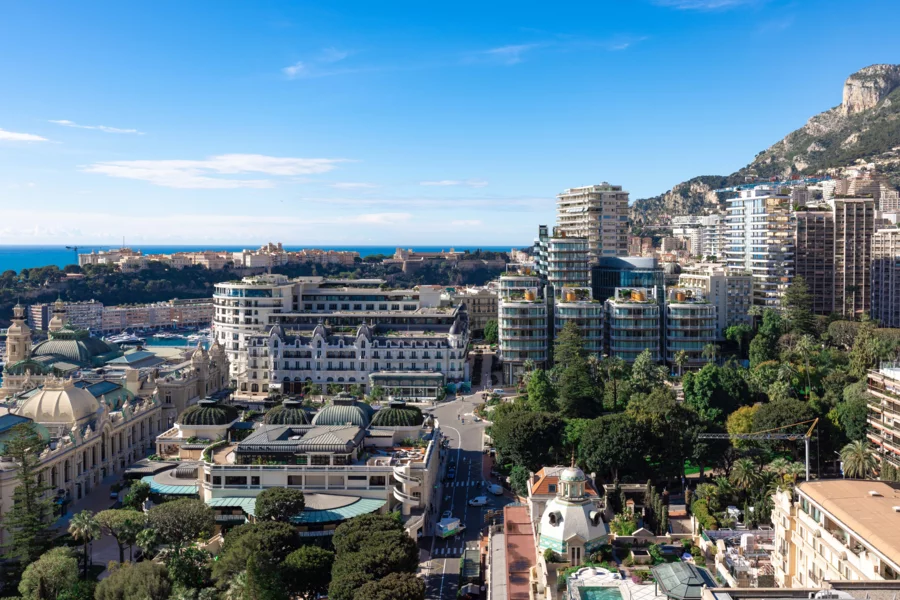
The difference is simple: Monaco is a country, Monte-Carlo is one of its districts, located inside that country.
Discover our selection of apartments
for sale in Monaco
for sale in Monaco
Studios, one- to five-bedroom apartments, penthouses and prestigious properties
The confusion is an old one, sustained by the Grand Prix, by the Rally and by a century of travel posters. English-language guidebooks and newspapers still use the two names interchangeably, which keeps it alive. It costs nothing in conversation. It costs a great deal more as soon as you look for an address, book a hotel or fill in a form, because it suggests that two separate places exist. I hear this question every week at the agency, and it deserves better than a three-word answer.
The simplest way is to think in nested layers. The Principality of Monaco is the State. Inside that State, the territory is divided into districts. Monte-Carlo is one of them. And inside Monte-Carlo, property professionals use the name Carré d'Or for a narrow perimeter that has no official existence whatsoever.
Key takeawaysMonaco and Monte-Carlo difference
Key takeaways: the difference between Monaco and Monte-Carlo
The difference between Monaco and Monte-Carlo fits into one sentence: one name designates the country, the other one of its districts. Here are the essential markers.
- — Monaco is a sovereign State and a member of the United Nations since 1993; Monte-Carlo is one of its districts, the one around Casino Square.
- — Monte-Carlo is neither a city nor a municipality: the Principality is a city-State whose territory coincides with a single commune.
- — The district was named Monte-Carlo in 1866, in tribute to Prince Charles III, on the Spélugues plateau.
- — Monte-Carlo occupies the eastern part of the Principality, between Larvotto to the east and Port Hercule below.
- — Monaco covers 2.08 km²: walking from one district to another often takes less than ten minutes.
- — The Carré d'Or is a perimeter inside Monte-Carlo with no official boundary: it is a market convention whose limits vary from one professional to another.
- — The name even spills beyond the Principality: the Monte-Carlo Beach stands on the French commune of Roquebrune-Cap-Martin.
- — In practice: Monaco for the country, Monte-Carlo for the district.
Practical advice: before starting a property search, a booking or an administrative procedure, make clear whether you mean the country or the district. The same sentence does not carry the same meaning from one person to the next.
What is the difference between Monaco and Monte-Carlo?
Monaco is a sovereign State, Monte-Carlo a district located inside that State. The Principality of Monaco has been a member of the United Nations since 1993 and has its own government, police force, courts and administration. Monte-Carlo has no border, no political status and no representation of its own: it is an internal division of Monegasque territory.
The distinction has very concrete consequences. A company is not registered in Monte-Carlo but in Monaco, a resident does not obtain a Monte-Carlo residence card but a Monegasque one, and no passport ever mentions the name of a district. This is precisely why Monaco's status as a sovereign State is worth recalling before any administrative or property step.
A Monegasque address therefore opens the same rights and the same obligations everywhere, whether it stands in Monte-Carlo, at Jardin Exotique or in Fontvieille. What changes from one district to the next is geography and atmosphere: altitude, closeness to the sea, the age of the buildings, the life of the street.
Is Monte-Carlo a city?
No. Monte-Carlo is neither a city nor a municipality: it is a district, and there is no town hall and no mayor of Monte-Carlo. The Principality is a city-State whose territory coincides with a single commune. Nothing above the district plays the role of a municipal authority.
That was not always the case, and this is precisely where the confusion comes from. The Constitution of 5 January 1911 divided the territory into three separate communes, Monaco-Ville, La Condamine and Monte-Carlo, each with its own mayor and its own municipal council. The experiment was short-lived: the Ordinance of 18 November 1917, which amended Article 37 of that Constitution, restored the principle that the Principality forms a single commune, and the first council of the reunified commune was elected in 1918 (consolidated text published by Legimonaco). Monte-Carlo therefore genuinely was a commune, for just under seven years. When you hear someone mention “the city of Monte-Carlo”, the mistake belongs to the present, not to the past.
The word district itself deserves to be handled with care. The Monegasque division of the territory has evolved along with land reclamation and successive censuses, and the administration now reasons in finer sectors than the landmarks inherited from the nineteenth century. Monte-Carlo remains one of the most stable of them, but its precise limits are engraved in no shared memory, residents included.
Where is Monte-Carlo on the map of Monaco?
Monte-Carlo occupies the eastern part of the Principality, on the heights overlooking the Mediterranean, around Casino Square and the gardens that extend it. The district opens onto Larvotto and its beaches to the east, and looks down on Port Hercule and La Condamine to the west.
Three landmarks are enough to place it mentally on a map. Casino Square and its gardens form the centre of gravity. Avenue Princesse Grace runs east along the shore, as far as the Larvotto beaches. To the west, the slope drops towards Port Hercule and its quays. Boulevard des Moulins crosses the district higher up and links it to the sectors climbing towards the eastern border of the country. Visible landmarks do the rest: the Casino and its opera house, the Hôtel de Paris and the Hôtel Hermitage, the terraced gardens running down to the sea, and the residential towers aligned along the ridge.
One last point helps avoid mistakes: the district has no entrance sign and no boundary marked on the ground. You move from La Condamine into Monte-Carlo by climbing a ramp, with nothing to signal it. This is also why tourist maps and property maps do not always draw the line in the same place.
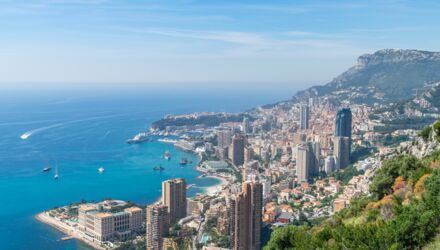
Monaco lies on the Mediterranean coast, between Nice and Italy, enclosed by the French department of Alpes-Maritimes on its three land sides. The country covers 2.08 km² since the delivery of Mareterra, which makes it the second smallest State in the world after the Vatican. Measuring the real surface area of the Principality helps grasp the essential point: at that scale, walking from one district to another often takes less than ten minutes.
Monte-Carlo is obviously not alone on that map. The Principality counts around ten districts and sectors, from the rock of Monaco-Ville to Fontvieille by way of La Condamine, Larvotto and Mareterra, listed in our overview of the districts of the Principality rather than in this article, deliberately centred on vocabulary.
Where does the name Monte-Carlo come from?
The district was named Monte-Carlo in 1866, in tribute to Prince Charles III, on the Spélugues plateau where the gaming house had just opened. The name literally means Mount Charles.
The wager was economic before it was toponymic. The Principality had just lost Menton and Roquebrune, and the casino was meant to replace the vanished revenue. The Société des Bains de Mer, created to run the establishment, added the Hôtel de Paris and then the Salle Garnier, and that trio projected the name far beyond the few hectares it designated, to the point of eclipsing the name of the State in the international imagination. Few districts are more famous than their own country.
The name ended up spilling beyond the Principality itself. The Monte-Carlo Rally is mostly run on the roads of the French Alps, and the Monte-Carlo Beach actually stands on the French commune of Roquebrune-Cap-Martin, on the other side of the border. The word has become a brand as much as a place, which explains a good share of the misunderstandings.
What is the Carré d'Or in Monte-Carlo?
The Carré d'Or is a narrow perimeter located inside Monte-Carlo, around the Casino and the Hôtel de Paris, and it corresponds to no official division. It is neither an administrative district nor a statistical unit: it is a market convention, born of the language of property professionals.
Its limits vary from one agency to the next. Some reduce it to the immediate surroundings of Casino Square, others extend it as far as Boulevard des Moulins. The perimeter I use runs from the Casino and the Hôtel de Paris to the One Monte-Carlo development and the Metropole, covering Avenue de Monte-Carlo, Avenue des Beaux-Arts, Avenue de la Costa and the lower part of Boulevard des Moulins. When two professionals describe the Carré d'Or differently, the gap usually comes from their respective perimeters rather than from the reality on the ground.
One market figure deserves to be quoted here, because it throws direct light on the vocabulary: the Monegasque price premium concentrates on the Carré d'Or and not on Monte-Carlo as a whole, with a gap of +32.8 % between the Carré d'Or and Monte-Carlo, according to Petrini Exclusive Real Estate data, 2026 asking prices and not recorded transaction prices. The detail of that reading sits on our page devoted to the Monte-Carlo district rather than in this article.
Monaco, Monte-Carlo, Carré d'Or: what each name refers to
Nature of the place, official status and average 2026 asking sale price, in euros per square metre.
| Name | What the name refers to | Official status | Average 2026 asking sale price |
|---|---|---|---|
| Monaco | A sovereign state | Single commune of the Principality | 59,929 €/m² |
| Monte-Carlo | A district of that state | Administrative district | 57,574 €/m² |
| Carré d'Or | A market perimeter inside that district | No official existence, a convention among professionals | 76,460 €/m² |
Table produced by Petrini Exclusive Real Estate Monaco. Petrini Exclusive Real Estate data, 2026 asking prices: averages of advertised sale prices, not recorded transaction prices.
Should you say Monaco or Monte-Carlo?
Say Monaco for the country, and Monte-Carlo for the district. The rule is simple and covers almost every situation. The official postal address mentions Monaco whatever the district, even if commercial usage sometimes puts Monte-Carlo on shopfronts and letterheads.
This precision is not merely a matter of language. Some buyers use Monte-Carlo as a pure prestige label and close doors on themselves, whereas the Fontvieille district offers newer buildings, floor areas better calibrated for families and a far more legible urban layout. The first question to ask is therefore not "which district?" but "what do you expect from your address?".
Three reflexes prevent most misunderstandings:
- Say Monaco for everything that concerns the country, residency, taxation or administrative procedures.
- Keep Monte-Carlo for location, when you are describing a building, a hotel, a restaurant or a route.
- When the person you are speaking to says Monte-Carlo, check whether they mean the district or the whole country.
What remains is the paradox that gives this confusion its charm. Monte-Carlo is probably the best known name of the Principality, and it designates only a part of it. In Monaco, the word travels further than the place.
FAQMonaco and Monte-Carlo difference
Frequently asked questions about the difference between Monaco and Monte-Carlo
- Are Monte-Carlo and Monaco the same thing?
No, they are not the same thing. Monaco is a sovereign State, Monte-Carlo one of its districts, the one around Casino Square and the Hôtel de Paris. Monte-Carlo has no border, no political status and no town hall: all its addresses are Monegasque, but not all Monegasque addresses are in Monte-Carlo. - Where exactly is Monte-Carlo?
Monte-Carlo occupies the eastern part of the Principality of Monaco, on the heights overlooking the Mediterranean, around Casino Square. The district opens onto Larvotto to the east and looks down on Port Hercule and La Condamine to the west. Monaco itself lies between Nice and Italy, on the Mediterranean coast. - Is Monte-Carlo a city?
No, Monte-Carlo is a district and not a city: there is no town hall and no mayor of Monte-Carlo. The Principality is a city-State whose territory coincides with a single commune, so that no municipal level sits between the district and the State. - Is the Carré d'Or part of Monte-Carlo?
Yes, the Carré d'Or is a section of the Monte-Carlo district, around the Casino and the Hôtel de Paris. At Petrini Exclusive Real Estate we point out that no official text defines it and that it has no administrative boundary: it is a market convention whose limits vary from one professional to another. - Can you live in Monte-Carlo without being a Monegasque resident?
Buying or renting a home in Monte-Carlo does not require Monegasque residency, but living there permanently requires a residence card issued by the Monegasque authorities. The rule is identical in every district: Monte-Carlo opens no special status.
Author

Nos derniers biens disponibles
 Sole agent
7 000 €
+ Charges
: 225
€
Sole agent
7 000 €
+ Charges
: 225
€
Buckingham Palace · Monte-Carlo
Stylish renovated one bedroom apartment in the heart of Monaco – The Buckingham Palace
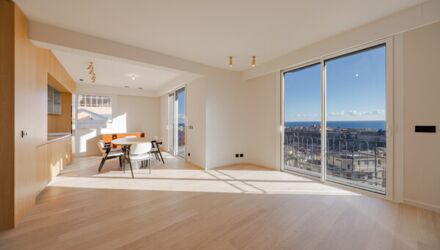
In the heart of Monaco, in the Buckingham Palace residence, discover this completely renovated apartment of 57.50 m², including 9 m² of balcony, offering quality contemporary services.
 2 650 000 €
Résidence Saint Georges · La Rousse - Saint Roman
Large 2 room apartment - Luxury residence
Located within the Résidence Saint Georges, a sought-after residence with concierge service, this beautiful 81 m² apartment benefits from a quiet environment while being in the immediate vicinity of shops, the Larvotto beaches and all amenities.
 Sole agent
Price on request
Sole agent
Price on request
Palais du Printemps · Moneghetti
Magnificent renovated penthouse with sea views - Le Palais du Printemps
In the heart of the Moneghetti, discover this duplex penthouse, a perfect fusion between the elegance of a bourgeois building and a contemporary renovation. Climb up its internal staircase and let yourself be surprised by a large roof terrace, equipped with a pergola and a summer kitchen, revealing a breathtaking view of the Mediterranean Sea.
Recherches fréquentes
Les derniers articles



Contact our real estate agency in Monaco




In which district would you like to search for your future apartment?