In Monaco, you buy a lot, not square metres
Publié par Paolo Petrini
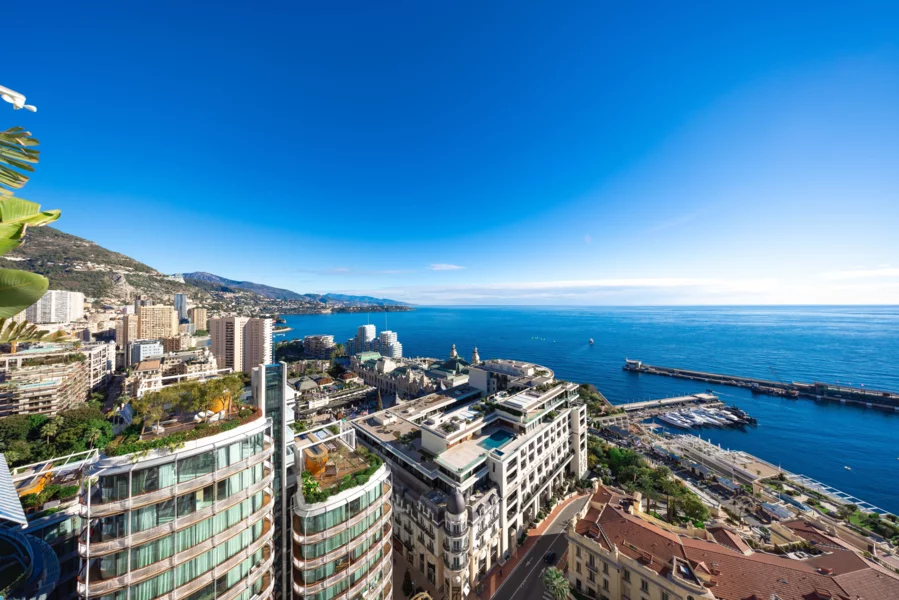
In Monaco, a property is sold as a lot: the marketed floor area carries no specific legal guarantee and does not appear on the deed of sale signed before the notary. Hence the golden rule of the Monegasque market: square metres are verified before signing.
Discover our selection of apartments
for sale in Monaco
for sale in Monaco
Studios, one- to five-bedroom apartments, penthouses and prestigious properties
The rule often surfaces during a viewing, prompted by a question asked a thousand times: what is the exact floor area? The Monegasque answer rests on a distinction few markets uphold so consistently: the contract concerns a lot, not a measurement. The surface is no less an essential piece of information, one that must be accurate and that both seller and buyer have every interest in documenting beforehand.
This subtlety deserves more than a footnote: it reflects the entire logic of the Monegasque transaction. Here is exactly what selling by the lot involves, how surfaces are truly measured in the Principality, and the reflexes that protect sellers and buyers alike.
Key takeawaysSelling by the lot in Monaco
Key takeaways: selling by the lot in Monaco
Selling by the lot in Monaco means you buy an identified co-ownership unit, not a guaranteed floor area. Six points to understand the rule in 2026.
PrincipleIn Monaco, a home is sold as a lot: the marketed floor area is not guaranteed by the deed of sale and is verified before signing.
Legal guaranteeAs in the UK, where caveat emptor prevails, no Monegasque statute guarantees floor area or imposes a certified measurement; the buyer checks before signing.
Deed of saleThe Monegasque notarial deed describes a lot number, its shares and its dependencies (cellar, parking), with no guaranteed surface.
Measurement customNo legal scale: floor area follows market customs. IMSEE counts balconies and loggias at 100% for its statistics; in valuation, outdoor spaces are weighted by size, often reduced for large terraces.
What is at stakeAccording to Petrini Exclusive Real Estate's observations, a square metre trades between €30,000 and €130,000 in Monaco in 2026: every metre counts.
ReflexBefore selling or buying, the property's floor plan and a surveyor's measurement secure the transaction better than any average per square metre.
Petrini insight: in Monaco, value is not read off a tape measure. Two lots of identical surface can be worth twice as much one over the other, depending on the floor, the view, the terraces and the dependencies attached to the lot.
What does selling a lot in Monaco mean?
A lot, in Monaco, is quite simply the property you buy or sell: an apartment, a penthouse or a villa, treated as a whole unit. The word "lot" is the legal term; the property itself remains the apartment or villa you know. Legally, selling that property means transferring the lot or lots identified in the title deed and the co-ownership documents, each comprising a private part and a share of the common areas, along with, where applicable, the ancillary lots expressly included in the sale, such as a cellar, a parking space or an attic.
The sale therefore concerns, first and foremost, the legal identity and substance of the lots transferred, and not the mere indication of a floor area. That surface nonetheless remains a material feature of the property, one that must be communicated accurately when stated: as we shall see, the Monegasque courts have already penalised inaccurate floor-area information.
The notarial deed of sale describes the lots, their building, the property's history and the rights attached to it. Monegasque co-ownership is governed by Law No. 1.329 of 8 January 2007, modernised by Law No. 1.531 of 29 July 2022; neither text imposes a certified measurement nor makes the floor area a constitutive element of the sale, unlike the French framework.
The official statistics bear the mark of this. IMSEE, the Monegasque statistics institute, calculates the market's average price only on transactions whose surface is known: 427 of the 470 resales in 2025, or 90.9%. Nearly one resale in ten therefore closes without the surface being recorded in the official data; the published averages, which we detail on our page dedicated to the price per m² in Monaco, describe the market, never the value of a particular lot.
In practical terms, whether it is a studio, a family apartment, a penthouse with a terrace or a villa, when you buy a three-bedroom home in Monte-Carlo, you buy the lot or lots designated in the deed, together with the ancillary items expressly included such as the cellar or the parking space: a patrimonial whole, an address, a floor, a layout. These are precisely the exceptional properties, from the studio to the penthouse, that we handle both for sale and for purchase. The surface, for its part, is verified and documented: it characterises the property, but it is not what the commitment is about.
Yet most international buyers approach the Principality with another country's framework in mind, whether the common-law logic of caveat emptor or a statutory guarantee of floor area.
Does a floor-area guarantee apply in Monaco?
No. In common-law markets the guiding principle is caveat emptor: the buyer investigates the property, and floor area follows professional practice (RICS), not a statutory guarantee. Even the systems that go further and grant a buyer redress for a short measurement have no equivalent here: in Monaco no statute guarantees floor area, and nothing suggests one is coming.
The consequence must be clearly understood: in Monaco, a discrepancy in surface discovered after the sale does not open this automatic right to a price reduction. Picture one of the three-bedroom apartments for sale in Monaco advertised at 165 m², which a later measurement puts at 158 m²: the buyer cannot demand a proportionate price reduction from the seller as in France, because they bought the lot or lots designated in the deed, where the surface does not feature as a warranty of area.
This should be seen as neither opacity nor a trap: it is the custom of the market, known and applied by every Monegasque professional, and offset by rigorous documentation. As our clientele is overwhelmingly international, the question of a guaranteed floor area in fact reaches us less from buyers themselves than from their French advisers, notaries or lawyers accustomed to that framework. The answer is always the same: in Monaco, the surface is verified before signing, not after. Which raises the question of what happens when, despite every precaution, a disagreement arises.
What happens if the floor area is disputed in Monaco?
A buyer who discovers a discrepancy in surface is not left without remedy: absent a specific recourse, the dispute is settled under Monegasque common law, and the Principality's courts have already ruled on contested-surface cases. Their line is consistent: no automatic warranty of area, but a demand for rigour from professionals.
The legal grounds that can be relied upon do exist. Mistake and fraud under Article 964 of the Civil Code concern the buyer's consent; the duty to inform and advise, for its part, grounds the professional's contractual liability. Each situation is assessed case by case, according to what was stated, documented and verified before signing.
The clearest precedent dates from 2020. On the basis of Articles 1830 and 1831 of the Civil Code, the Monaco Court of Appeal held liable an estate agent who had passed on inaccurate information about the surface of an apartment and its parking space to his principal, this being a decisive factor for a rental investment: €300,000 for loss of opportunity at first instance, to which the Court added €50,000 for the parking space (judgment of 28 January 2020, published on Legimonaco with the note "strong jurisprudential interest").
The same case law also protects diligent professionals. In October 2024, the Court of First Instance dismissed any breach of the duty to inform and advise by an agency whose prospective buyer had withdrawn after exchanges concerning precisely the property's surface. And as early as 2002, in a lease matter, the Court of Appeal refused a rent reduction based on the size of the premises, since the parties knew them perfectly well and had not made that figure an essential element of their agreement.
It is in this light, too, that one should read the "floor areas given for guidance only" notices found on Monegasque marketing documents. They usefully recall the non-contractual nature of the figure; they do not exempt anyone from communicating accurate information, as the 2020 judgment shows. The best protection, for seller and buyer alike, therefore remains the same: a documented file before signing, rather than an uncertain dispute afterwards. But before counting the metres, one must first agree on how to measure them.
How is a floor area measured in Monaco?
There is no legal measurement scale in Monaco: surface is calculated according to market customs, never according to an enforceable standard. One starts from the interior surface of the lot, to which is added half the thickness of the walls separating it from the common areas.
Beyond that, two quite distinct logics coexist, and confusing them would be a mistake. For its statistics alone, IMSEE uses a counting convention, balconies and loggias at 100%, roof terraces and gardens at 50%, designed to standardise thousands of transactions in order to calculate its price-per-square-metre index, never to value a specific property (methodological note of its 2025 Property Observatory, page 22). To value an apartment, practice is more nuanced: outdoor spaces are weighted by their scale, and a vast exceptional terrace is rarely counted at one hundred percent, often at half, sometimes less, because a large volume of open air does not command, per square metre, the value of living space.
There is therefore no single rule, and this is precisely what makes the judgement of a local expert indispensable, ideally supported by a survey from a surveyor or architect. This flexibility also explains why a Monegasque surface is not directly comparable to a surface measured with walls and partitions deducted, as national floor-area rules require elsewhere.
Where do the advertised surfaces come from? From the building's original plans, most often, and from what owners themselves were told when they bought: in Monaco, an apartment's surface is passed on from hand to hand, like the property itself. This is where depth of archives makes the difference: the archives built up and carefully preserved for more than forty years by Eugenia Petrini, co-founder of our agency, very often allow us to retrieve the original plans of a known residence and to substantiate an advertised surface, where a recent outfit can only relay the declared figures.
The most delicate case is that of renovated period buildings, whose original plans have sometimes disappeared. Our practice is then unwavering: recommend a surveyor's measurement before listing, and arrange it on the owner's behalf. As the square metres shown in a listing are not contractual, this upstream verification is the only way to know precisely what is being sold, and what is being bought.
If this arrangement is disconcerting, it is often because it is compared to a single model, the French one. The international picture tells another story.
How do other countries treat an apartment's floor area?
Each market applies its own measurement convention and its own level of guarantee, and the table below deserves careful reading: Monaco does not stand out as an exception. The French-style statutory floor-area guarantee is the exception worldwide, not the rule, and the Principality in fact operates like most of the major international markets, from London to New York.
Floor area in property sales: seven markets, seven rules
Sources: national official texts (loi Carrez 1996, DPR 138/1998, WoFlV 2004), professional standards (RICS, SIA 416, IPMS), market customs. 2026 overview.
| Market | Measurement convention | Contractual area | Buyer's recourse |
|---|---|---|---|
| Monaco | Market custom, no legal scale: interior + half-walls; outdoor spaces weighted by scale, often reduced | No: you sell a lot | No specific recourse: verify before signing |
| France | Private area under the loi Carrez (1996), walls and partitions deducted | Yes, in co-ownership | Price reduction if the gap exceeds 5%, action within 1 year |
| Italy | Commercial surface (DPR 138/1998): walls at 100%, party walls at 50% | No, in an "a corpo" sale, the dominant practice | Adjustment only if the gap exceeds 1/20 (Art. 1538 c.c.) |
| United Kingdom | RICS professional practice, areas in sq ft (GIA) | No | Caveat emptor: the buyer verifies, recourse limited to misrepresentation |
| Switzerland | SIA 416 professional standard, voluntary application | No, unless expressly stipulated | Per the contract; listing practices vary |
| Germany | WoFlV 2004: balconies at 25%, reduced sloped ceilings | Mainly in rentals | Gap over 10% = rent reduction (federal case law) |
| New York | Measured to the exterior walls, loss factor of 27 to 30% | No: declared estimate | Very limited once the estimate is disclosed |
Table compiled by Petrini Exclusive Real Estate Monaco. Indicative overview of the rules applicable to residential sales; each situation should be assessed with local advice.
The most telling parallel is Italy: the Monegasque convention is the direct cousin of the Italian commercial surface, which likewise counts half the party walls, and the sale by the lot works like the "vendita a corpo" of the Italian Civil Code, where the property is sold as a whole. As for attempts at global harmonisation, the IPMS standards launched in 2014 made the point: depending on the convention chosen, the surface of the very same apartment can vary by up to 24%. There is no universal square metre; there are local conventions, and experts who master them.
What reflexes before buying a lot in Monaco?
The golden rule fits in a sentence: everything is verified before signing. Here is the method we apply and recommend to every buyer in the Principality.
- Ask for the property's floor plan and, if none exists, have one drawn up: it is the exact picture of what you are buying.
- Ask where the advertised surfaces come from: the building's original plan, a recent surveyor's measurement or the owner's mere declaration do not carry the same weight.
- Have a measurement carried out by a surveyor or an architect in case of doubt, before making an offer: in a market where the square metre trades between €30,000 and €130,000 on our observations, the cost of a survey is negligible against the stakes.
- Examine the exact composition of the lot: cellar, parking, attic and shares attached to it, which are an integral part of the value.
- Think in terms of the lot's value, from real comparables in the building and the district, never by multiplying an average per square metre.
Almost every Monegasque transaction proceeds without the slightest difficulty: this vigilance is a matter of good method, not distrust. It forms part of an overall preparation that our guide to buying property in Monaco sets out, from choosing the district to signing before the notary.
The surface is, moreover, only one line of the budget: to the price of the lot are added the purchase costs in Monaco, whose scales are likewise calculated before any offer.
The whole falls into place within a well-mapped high-end property purchase process, where anticipation prevails at every step, from the viewing to the notarial deed.
How to prepare the sale of your lot in Monaco?
By documenting it before listing: a well-documented lot sells better, faster and without any possible dispute. It is the exact mirror of the buyer's reflexes.
As soon as a sale mandate is signed, our agency gathers the title deed, the property's history, the floor plan and any existing measurements. When the plan is missing, particularly in older renovated buildings, we systematically recommend a surveyor's involvement before marketing, and we arrange the whole process on the owner's behalf. The cost varies with the property's size; it is, as we often tell our selling clients, the price of peace of mind.
This preparation has a twofold virtue. Commercially, it allows justified features to be advertised and each component of the lot to be showcased, from terraces to dependencies. Legally, it protects the seller: since the advertised surface is not contractual, it is the quality of the documentation handed to the buyer that forestalls any later discussion. The valuation itself follows the same logic. At equal surface, two Monegasque lots can be worth twice as much one over the other: the floor, the sea view, the terraces, the cellar and the parking attached to the lot, the property's condition, the quality of the building and the district each weigh more than one square metre more or less. We therefore value a lot, its address, its rights and its real comparables, never a mere multiplication of square metres.
This is where the choice of adviser makes all the difference. Selling a lot in Monaco requires knowing the buildings one by one, holding real comparables and knowing which clientele each property speaks to, a fine-grained reading that only a long presence on the market makes it possible to acquire. This is the strength of Petrini Exclusive Real Estate Monaco, one of the few Monegasque houses to publish recurring market analyses and to keep the memory of residences and their transactions. This depth of expertise, more than a mere mandate, secures the sale, reassures the buyer and defends the property's fair price, from the first appointment to the signing.
One question remains, one that foreign observers regularly ask: is this Monegasque particularity here to stay?
Will Monaco one day adopt a contractual floor area?
Nothing suggests it to date: recent reforms have professionalised the market's players without touching the principle of selling by the lot. Law No. 1.531 of 29 July 2022 modernised co-ownership, Law No. 1.560 of 2 July 2024 regulated the activity of property dealers in Monaco with financial guarantees and compliance certificates, and bill No. 271 passed by the National Council on 24 September 2025 is preparing an overhaul of the property professions: written mandates, professional cards, regulation of advertising. None of these texts introduces a certified measurement or a guaranteed floor area.
Monegasque law is therefore genuinely evolving, but in a direction consistent with the spirit of the market: strengthening the reliability of professionals rather than imposing a numerical guarantee. Buyer protection here rests on ethics, documentation and guidance, not on floor-area litigation.
Monaco is a sovereign state with rules of its own: wall thickness counts within the square metres, weightings differ from those of Paris, Milan or London, and here one sells lots. The role of a Monegasque professional is to explain these rules transparently and to give everyone the keys to a territory that is, quite literally, a country. This is the spirit of this article: to enable an owner and an international buyer alike to understand how a sale truly works here, and to approach their project with guidance that adapts to each person's language and frame of reference.
In Monaco, you do not buy a surface, you acquire a lot: an address, a floor, a view, dependencies and rights, of which the surface is only one feature among others, to be established accurately rather than taken for granted. In a market where every square metre carries the price of a collector's car, this culture of the verified file, rather than the assumed figure, is not one more Monegasque idiosyncrasy: it is the best protection for seller and buyer alike.
FAQSelling by the lot in Monaco
Your questions on selling by the lot in Monaco
- Does the floor area appear on the deed of sale in Monaco?
No. The Monegasque notarial deed describes a lot: its number, its shares of the common areas and its dependencies such as the cellar or the parking space. The marketed surface is not carried over as a contractual commitment, unlike French practice: verifying it before signing is therefore essential. - Can the floor area be contested after a purchase in Monaco?
There is no automatic right in Monaco to a price reduction for a surface discrepancy, as there is in French law. Common-law actions remain possible depending on the circumstances, the Monegasque courts having already penalised inaccurate floor-area information: verification before signing nonetheless remains the best protection. - How can you verify an apartment's floor area before buying in Monaco?
By asking for the property's floor plan and the source of the advertised surfaces, then by having a surveyor or architect carry out a measurement in case of doubt, before making an offer. In a market where the square metre trades between €30,000 and €130,000, this prior check is the only real safeguard. - Do terraces and loggias count in the floor area in Monaco?
In part, and with no legal scale. For its statistics, IMSEE counts balconies and loggias at 100% and roof terraces and gardens at 50%. But to value a property, the weighting of outdoor spaces varies with their scale: a large terrace is often counted at half, sometimes less. Only a local expert decides case by case. - Should you have your apartment measured before selling it in Monaco?
Yes, whenever the plan is missing or the surfaces are uncertain. Petrini Exclusive Real Estate Monaco systematically recommends a surveyor's measurement before listing and arranges it for its clients: a documented lot sells better, faster and without any possible dispute.
Author

Nos derniers biens disponibles
 Sole agent
7 000 €
+ Charges
: 225
€
Sole agent
7 000 €
+ Charges
: 225
€
Buckingham Palace · Monte-Carlo
Stylish renovated one bedroom apartment in the heart of Monaco – The Buckingham Palace
In the heart of Monaco, in the Buckingham Palace residence, discover this completely renovated apartment of 57.50 m², including 9 m² of balcony, offering quality contemporary services.
 2 650 000 €
Résidence Saint Georges · La Rousse - Saint Roman
Large 2 room apartment - Luxury residence
Located within the Résidence Saint Georges, a sought-after residence with concierge service, this beautiful 81 m² apartment benefits from a quiet environment while being in the immediate vicinity of shops, the Larvotto beaches and all amenities.
 Sole agent
Price on request
Sole agent
Price on request
Palais du Printemps · Moneghetti
Magnificent renovated penthouse with sea views - Le Palais du Printemps
In the heart of the Moneghetti, discover this duplex penthouse, a perfect fusion between the elegance of a bourgeois building and a contemporary renovation. Climb up its internal staircase and let yourself be surprised by a large roof terrace, equipped with a pergola and a summer kitchen, revealing a breathtaking view of the Mediterranean Sea.
Recherches fréquentes
Les derniers articles


The notaries of Monaco
More Information

Contact our real estate agency in Monaco




In which district would you like to search for your future apartment?