Buying Into an Old Building in Monaco to Own Tomorrow's New One
Publié par Paolo Petrini le 30/09/2026
Temps de lecture
19
min.
Real Estate Advice
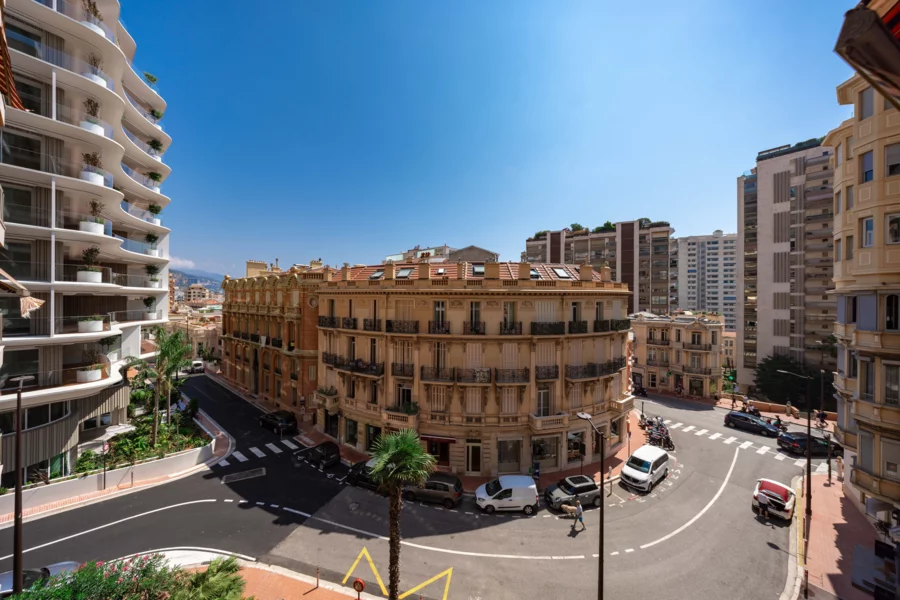
Because in Monaco, an old building often holds within it the new one that will one day take its place.
Discover our selection of apartments
for sale in Monaco
for sale in Monaco
Studios, one- to five-bedroom apartments, penthouses and prestigious properties
At the foot of the Principality's glass towers stand buildings that their era seems to have forgotten. Six or seven storeys of tired render, a narrow stairwell, no parking, no concierge. The passer-by sees a relic, almost an anomaly in the scenery. A developer sees something else entirely: a plot of land, in a country that has none left.
On a territory of 2.08 km² that only the sea could still enlarge, every new square metre must now be won from an old one. Monaco no longer grows outward; it replaces itself, and that replacement follows a logic that a handful of investors learned to read before everyone else. Their method fits in a single sentence: buy an apartment in an old building, let it, then wait for the day a developer arrives offering, in exchange, a new apartment in the building that will rise in its place.
The strategy is rarely discussed. It lends itself neither to glossy brochures nor to promised yields, because it is measured in decades and rests on legal rules that most foreign buyers have never encountered. It nonetheless deserves to be set out in detail, for it reveals something essential about Monaco real estate investment, and about how value forms in a market where a building's age can become its greatest asset.
Key takeaways: investing in an old building in Monaco
Buying into an old building means buying an apartment and, as a bonus, the chance of one day receiving a new one. Here are the rules that make the wager possible, and its limits.
- Monaco covers 2.08 km²: with no further extension into the sea on the horizon, the city creates its housing by adding storeys to its old buildings or by rebuilding them.
- To rebuild a building held in co-ownership, a developer must secure the agreement of every owner, paying each one either in cash or in kind, that is, with a new apartment in the future building.
- In our observation, the in-kind exchange generally takes the form of an apartment one floor higher with 10 to 15% more floor space, the proportions varying from one project to the next.
- Laws No. 1.235 and No. 887 govern the letting of homes built or completed before 1 September 1947, which make up the so-called protected sector.
- A building that is demolished and rebuilt leaves these regimes: on 12 July 2022, the Tribunal Suprême struck down the provision of Law No. 1.508 that sought to keep rebuilt homes within them.
- In the event of demolition, Law No. 1.235 provides for six months' notice and for the protected tenant to be rehoused by the State, with the owner paying compensation to the State.
- The strategy is conceived over some twenty years, with no guarantee that the building will ever be rebuilt.
Petrini tip: never buy an apartment solely for the prospect of its demolition. It must remain a sound purchase even if the building never comes down: reconstruction is an option, not a promise.
A city that rebuilds on top of itself
Monaco produces most of its new housing by demolishing and rebuilding its old buildings, because its territory can no longer expand.
Monaco has never stopped rebuilding itself, and what it replaces is not its heritage, which it protects, but worn-out building stock that has served its time. Buildings too low for their location, without parking or lifts suited to their height, designed to standards of comfort, insulation and safety from another age. Rebuilding them is less a matter of demolition than of optimisation: on the same plot, housing more families, better, and to today's standards. Each generation thus rewrites the city over the one before, without erasing what deserves to be kept.
For half a century, the sea offered a way out. Under Prince Rainier III, Fontvieille added 22 hectares to the territory; under Prince Albert II, Mareterra added 6. Such conquests are the work of a reign, long, costly and rare, and no new extension on that scale has been announced to date. For the coming generation, then, new Monaco will be born of old Monaco. The list of property projects expected by 2030 makes this abundantly clear, so large is the share taken by demolition and reconstruction.
Rebuilding does not always mean razing, however. The Schuylkill, on boulevard de Suisse, offers the most spectacular illustration. Built from 1963 onwards, the Principality's first high-rise has been undergoing a heavy rehabilitation since 2024, estimated at €170 million: its top three levels are being demolished and rebuilt, its structure reinforced and its basements extended, and the tower is due to offer 142 homes on completion, expected around 2028. Its builders present it as the first rehabilitation of this scale of a high-rise building in Monaco. We are following this Schuylkill rehabilitation project closely, because it shows that between preservation and demolition, the city also knows how to transform an entire tower without bringing it down.
The constraint of territory thus overturns a law once thought universal. Everywhere else, a building loses value as it ages, and the prudent investor knows it. In Monaco, a low, ageing building can be worth more for what it would allow to be built than for what it houses. Its value lies less in its walls than in the volume it occupies, and still more in the volume it does not yet occupy.
Which leaves a question: who owns that volume, and by what route does it change hands?
What the owner of an old apartment really owns
The owner of an apartment in a co-owned building holds their unit and a share of the common parts, which as a rule include the land: it is this share that a developer must assemble in order to rebuild, and it is often paid for in kind.
In practice, no developer demolishes a co-owned building without first assembling every unit. Each owner therefore holds a key to the operation, whatever the size of their apartment, and at the decisive moment the ground-floor studio weighs as much as the large apartment on the top floor. To obtain those keys, the developer has two currencies. The first is money: he buys the unit outright. The second is space: he promises the owner an apartment in the building to come. This second currency has a name, the “dation”, or payment in kind, and it often suits both sides. The developer avoids a cash outlay at the very moment his finances are most stretched; the owner trades a dated property for a new one.
In the transactions we observe, the in-kind exchange generally takes the form of an apartment one floor higher than the original unit, with 10 to 15% more floor space. These proportions are less a rule than a point of balance, and each project shifts it according to its own economics: the permitted height, the number of units to assemble, the developer's impatience, the owners' resolve. Everything else is negotiated, from the orientation of the new apartment to living arrangements during construction.
A New York reader will recognise the figure of the holdout, the last owner who refuses to sell and drives up the price of an entire land assemblage. A reader in Hong Kong will think instead of the mechanism that allows a large majority of owners, under certain conditions, to force the sale of an old building. The kinship ends there. To our knowledge, Monegasque law provides no equivalent for private transactions: each owner keeps control, and it is precisely this power that gives the in-kind exchange its value.
That power comes with a condition, however. It carries its full weight only if the building, once demolished, can be reborn free of its constraints. In Monaco, that condition hangs on a date.
1 September 1947, the date that makes the value
Homes built or completed before 1 September 1947 often fall under a protected rental regime, and that regime does not survive the building's demolition.
Two laws govern this pre-war housing stock. Law No. 1.235 of 28 December 2000 reserves the letting of these homes to protected persons, Monegasques first among them, and caps their rents. Law No. 887 of 25 June 1970 governs another part of the same stock along more flexible lines: the rent is free, but letting remains reserved for certain categories of tenant, registered with the Direction de l'Habitat. New York investors will think of rent stabilization, with its regulated rents and protected renewals. The kinship ends there: in Monaco, everything turns on the date the building was completed, and priority goes to Monegasque nationals. We have devoted a detailed guide to apartments under Law 887 and the terms on which they can be let.
For an owner, these regimes carry a very real cost: a regulated rent, a tenant one does not choose, a lease that renews itself. But their scope rests on a date, and a date does not move. A building demolished and rebuilt is, by definition, completed after 1947. Its new apartments join the free sector, where the owner sets the rent and chooses the tenant. The constraint that weighed on the old building disappears with it.
The legislature, moreover, anticipated the case. Article 14 of Law No. 1.235 allows an owner holding the necessary permits to demolish and rebuild, provided the protected tenant is informed within the month following the filing of the applications and given six months' notice. The tenant is then rehoused by the State, to which the owner pays compensation for each tenant rehoused. Article 14-1 extends the same logic to adding storeys: new homes created on top of an old building fall outside the protected regime.
What becomes of an older home when its building is rebuilt
Sources: Law No. 1.235 of 28 December 2000, consolidated text; Law No. 887 of 25 June 1970; Tribunal Suprême, decision of 12 July 2022 (Legimonaco).
| Regime | Before demolition | If the building is demolished | After reconstruction |
|---|---|---|---|
| Law No. 1.235 | Letting reserved for protected persons, capped rent | Six months' notice, tenant rehoused by the State, compensation paid by the owner to the State | New homes outside the regime, free sector |
| Law No. 887 | Free rent, letting reserved for certain categories of tenant | Regime ends with the disappearance of the old premises | New homes outside the regime, free sector |
| Older free-sector homes | Rent and tenant freely chosen | Owner's agreement, in cash or in kind | Free sector, in a new building |
Table by Petrini Exclusive Real Estate Monaco. A general reading of the law in force on 30 September 2026, which is no substitute for the analysis of a specific building and lease by a notary or lawyer.
This exit from the protected regime is the mainspring of the entire strategy. Barely four years ago, it very nearly disappeared.
2021-2022: the year the rule wavered
In 2021, a law sought to keep rebuilt homes within the protected sector; in 2022, the Tribunal Suprême struck that provision down in the name of property rights.
The protected sector answers an old and legitimate concern: allowing Monegasques and long-established families to go on finding a home in their own country. Yet every demolition erodes it a little further. To halt that erosion, Law No. 1.508 of 2 August 2021 required a rebuilt building to recreate homes subject to Law No. 1.235, in place of those that disappeared, and part of that floor space to be transferred to the State. The economics of reconstruction projects were profoundly altered.
Petitioned by property owners, the Tribunal Suprême annulled the core of this mechanism on 12 July 2022, as an excessive infringement of the right to property guaranteed by Article 24 of the Constitution. Its decision, published on Legimonaco, rendered inapplicable the regime on which demolition and reconstruction permits had been made conditional. As the law stands, a rebuilt building therefore leaves the protected sector.
The episode teaches more than a rule. It is a reminder that the mainspring of the strategy is a political norm, revisited by each legislature, at the meeting point of two equally respectable demands: the social cohesion of a small country and the freedom of those who own property there. The Tribunal Suprême drew a line; it did not forbid the legislature from seeking a different balance. An investor reasoning over twenty years must accept that the rules of the game may change mid-play, without overstating that risk either.
The most immediate danger, however, is not legal. It lies in the choice of unit, and very often in who occupies it.
You do not buy a demolition, you buy a building
It is tempting to hunt for the building that is about to come down, as one might hunt for a winning lottery ticket. In our view, that is an error of method. No one can put a date on a reconstruction in Monaco: it depends on a developer's interest, the agreement of every co-owner, administrative permits and the legislative climate of the moment.
The right question is therefore the reverse. Would this apartment be a good purchase if the building never came down? If it is well located, easy to let and reasonably maintained, reconstruction becomes an option on the future that costs nothing extra. If it stands only on the promise of demolition, it is a gamble, and Monaco has never rewarded badly constructed gambles.
The protected tenant, a false bargain
An apartment occupied by a protected tenant costs less to buy, but it yields little, is sold under the State's watchful eye and is hard to vacate: we advise against it as a first choice.
On paper, the reasoning is seductive. A unit under Law No. 1.235 changes hands at a discount, since its rent is capped and its occupant enjoys a right of renewal. If the building is one day rebuilt, the law arranges for the State to rehouse the tenant. The investor would thus have acquired a future new apartment on the cheap.
Reality is more demanding. The purchase itself is regulated: Article 38 of Law No. 1.235 requires the seller to notify the sale to the Minister of State, a declaration that stands as an irrevocable offer to the State for one month and then, if the State declines, to the sitting tenant for fifteen days. The rent collected remains modest throughout the wait, which can last for years. As for a protected tenant's lease, it cannot be rewritten at the parties' convenience: the law sets its terms, and it protects its beneficiary firmly.
The law sets the framework; negotiation does the rest, and that is the heart of our profession. An amicable agreement with the occupant, such as rehousing paid for by the owner on equivalent or better terms, often frees a unit more surely than any legal calculation. The occupant must still see the benefit, however, and the agreement must be drafted with professional advice.
Yet the decisive moment comes earlier still, when the building is chosen.
Reading a building the way a developer does
Before the façade, a developer looks at the number of units, the location and the absence of heritage protection: these are the criteria that make a reconstruction possible.
The passer-by judges a building by its façade; the developer judges it by the land registry. And the first figure he looks for is the number of units. Every co-owner is a party to be won over, with their own expectations, their heirs and sometimes their quarrels. A small building of a few apartments is far easier to assemble than a large co-ownership, which may never get there. A building held by a small number of families, or in which several units already belong to the same owner, has a head start for the same reason.
Location comes next, because a developer rebuilds only where new apartments will sell at a high price: near the port, near the sea, along the main roads, in neighbourhoods undergoing change. The contrast in scale speaks volumes too. A low building wedged between two recent towers tells, on its own, the story of the volume still waiting to be used.
Heritage, finally, can stop everything. Monaco protects part of its building stock under Sovereign Ordinance No. 3.647 of 9 September 1966 on town planning, strengthened in 2018. In 2022, 110 buildings and 41 façades were protected, and both Monaco-Ville and the Sainte-Dévote valley come under a status that requires their character to be preserved. For a landmark building, demolition is permitted only under very restrictive conditions. An old apartment on the Rock is an investment of charm; it is not a reconstruction play.
These criteria draw a fairly simple map, that of the districts where the most old building stock survives. La Condamine is its heart. The port district, long working-class, retains a dense fabric of bourgeois and pre-war buildings at the foot of newer addresses, and each reconstruction lifts the street a little higher. The apartments for sale in La Condamine indeed mix these two worlds, sometimes only a few doors apart, and the area around rue Plati deserves the same attention.
To the west, the slopes of the Jardin Exotique district are home to many old buildings, in an area where the State itself is rebuilding to house Monegasques.
To the east, the old buildings of La Rousse and Saint-Roman, like those along boulevard d'Italie and boulevard des Moulins, stand alongside recent construction on streets where older stock remains plentiful.
None of these addresses is a promise. They merely mark the places where the raw material of the strategy still exists. There remains the one variable no one controls, and which nonetheless decides everything.
Time, the raw material of the strategy
This strategy is conceived over some twenty years, with no guaranteed date: the building may be rebuilt much sooner, or never.
That is what separates it from speculation. The investor does not bet on a date; the investor buys an asymmetry. If the building is never rebuilt, they own a let apartment in one of the scarcest markets in the world. If it is, they receive a new apartment, higher and larger, without having paid the price of new. The gain lies in the gap between the price of old and new on the same street, plus the square metres and the floor gained. That gap varies from one district to another and from one building to the next; it must be estimated before buying, not after.
Some investors go further and make time an explicit ally. They buy the bare ownership of an old apartment from an owner, often elderly, who retains the usufruct and goes on living there. The price is lower than that of full ownership, and the wait, which would be long in any case, is rewarded. Our guide to bare ownership in Monaco sets out how it works. If reconstruction comes during the usufruct, nothing can proceed without the usufructuary: they must give their consent and agree to be rehoused during the works. Each situation is settled case by case, with the notary, with respect for everyone's age and wishes.
The risks, for their part, deserve to be faced squarely. The timetable belongs to no one. A co-ownership can remain divided for decades. During construction, the owner loses the use of the property, and its rent, for several years, unless rehousing or compensation has been negotiated. And the apartment received in kind will be worth only what the market is worth on delivery. On this last point, our reading of the geography of capital in Monaco in 2026 recalls what the territory's structural scarcity does to values over the long term.
Everything therefore turns on an intimate knowledge of buildings. Knowing which have few units, which are held by a handful of families, which have already had a visit from a developer, which co-ownerships get along and which are at war: none of this appears in any database. It is built up building by building, through viewings, mandates and negotiations, and at Petrini it draws on more than forty years of archives on the Monegasque market. For those weighing a first purchase more broadly, our analysis should you buy in Monaco places this wager within an overall wealth decision.
Monaco will grow no larger. That is precisely why it will never stop rebuilding itself, and why its most modest-looking buildings sometimes shelter, beneath their weary roofs, a piece of tomorrow's city. The art lies in knowing which ones, and in having the patience to wait for them to reveal it.
Frequently asked questions on investing in older buildings
- What is a dation when a building is rebuilt in Monaco?
A dation is the payment in kind that a developer offers the owner of an apartment in a building earmarked for reconstruction: instead of a cash price, the owner receives a new apartment in the future building. The terms (floor, floor space, timetable and housing during construction) are negotiated case by case. - Does an apartment under Law 1.235 leave the protected sector after demolition?
Yes, as the law currently stands. Law No. 1.235 covers homes built or completed before 1 September 1947: a building that is demolished and rebuilt no longer falls within its scope. Law No. 1.508 of 2021 had sought to keep rebuilt homes under this regime, but the Tribunal Suprême annulled that provision on 12 July 2022. - How long should you expect to wait for an old building to be rebuilt?
Petrini Exclusive Real Estate Monaco advises thinking in terms of a horizon of some twenty years, with no guaranteed date. Reconstruction depends on a developer's interest, the agreement of every co-owner and administrative permits: it may happen much sooner, or never. - What apartment do you receive in a dation?
In the transactions observed in Monaco, a dation generally takes the form of an apartment one floor higher than the original unit, with 10 to 15% more floor space. These proportions vary from project to project and depend on negotiation with the developer. - Can you buy bare ownership in an old building as part of this strategy?
Yes. The buyer acquires the bare ownership from an owner, often elderly, who retains the usufruct and continues to occupy the apartment. If the building is rebuilt, the usufructuary must give their consent and agree to be rehoused during construction: each situation is settled case by case.
Further reading on investing in Monaco
Author

Nos derniers biens disponibles
 9 800 000 €
Riviera Palace · Monte-Carlo
Exceptional apartment with sea views & Casino
In the heart of Monte-Carlo, discover this superb 3-room apartment completely renovated, offering generous volumes and beautiful terraces with remarkable views of the sea and the Casino. A sought-after address, an elegant renovation and a privileged setting to fully enjoy the Monegasque art of living.
 3 600 000 €
Les Lierres · Monte-Carlo
FULLY RENOVATED BOURGEOIS APARTMENT - MONTE-CARLO
In the heart of Monte-Carlo, this elegant 75 m² three-room apartment has just benefited from a complete renovation with contemporary lines. Bright and perfectly arranged, it offers neat services in the privileged setting of a bourgeois building, in the immediate vicinity of all amenities.
 45 000 €
+ Charges
: 5 000
€
45 000 €
+ Charges
: 5 000
€
Le Metropole · Carré d'Or
Luxurious 5-room apartment in the heart of the Carré d'Or - Residence "Le Metropole"
In the luxurious Residence du Métropole, near the Casino de Monte-Carlo, we offer you this magnificent five-room apartment. The property has top-of-the-range services as well as a nice sea view and the gardens.
Recherches fréquentes
Les derniers articles




Contact our real estate agency in Monaco




In which district would you like to search for your future apartment?